Get Full Government Meeting Transcripts, Videos, & Alerts Forever!
Get email alerts on the Solar Glare Policy topic
No spam. Unsubscribe anytime.
Airport land-use commission adopts glare policy for solar panels; one commissioner objects
Summary
The Riverside County Airport Land Use Commission adopted Resolution 2025‑01 establishing glare limits for solar panels near airports and recommending anti‑reflective coatings or textured glass; the measure passed with one recorded opposition from Commissioner Michael Geller.
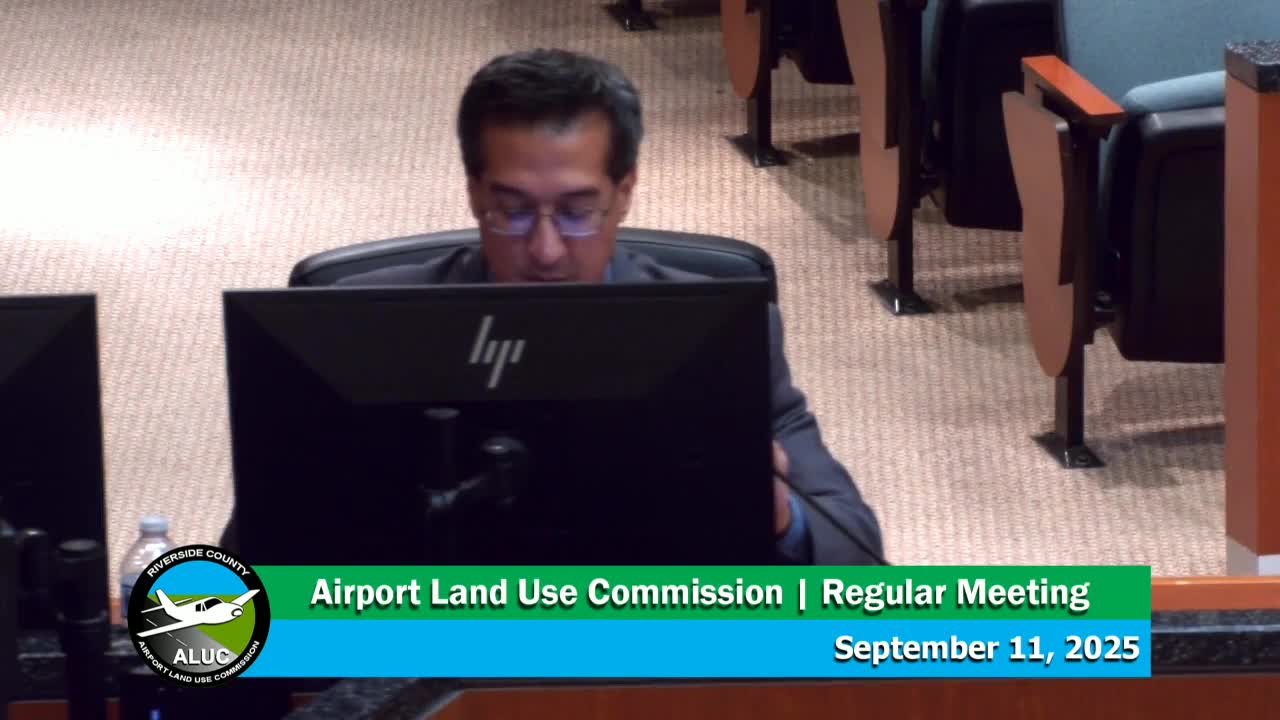
The Riverside County Airport Land Use Commission adopted Resolution 2025‑01 on solar‑panel glare policy during its regular meeting, directing that new solar projects minimize yellow and red glare and that applicants use anti‑reflective coatings or textured glass where feasible.
Paul Ruhl, the commission director, presented the staff report and said the resolution reaffirms the existing policy that green‑level glare is acceptable while yellow and red glare are prohibited. “Staff recommends that the commission adopt[] resolution number 2025‑01 regarding solar glare policy,” Ruhl said, summarizing recommended mitigations including anti‑reflective coatings and encouragement of tracking panels to reduce cumulative glare near flight paths.
Commissioner Michael Geller objected to adopting the policy without more information on availability and cost. “Idon’t think we should shut down solar development in a huge area of the county, at this moment in time without better and more information,” Geller said, raising concerns that required coating or textured glass might be unavailable or expensive, and warning of a potential supply‑chain impact on projects.
Other commissioners urged codifying protections to address cumulative glare as solar deployment expands. One commissioner noted staff research showing higher up‑front costs for anti‑glare panels but said those panels can increase per‑panel efficiency. Several members suggested staff could research availability and potential flexibility for projects facing supply issues; staff said it would follow up on those questions.
A motion to adopt the resolution as written passed; the clerk recorded Commissioner Geller as opposed and asked that the opposition be noted in the record. The resolution was adopted at the meeting with the stated mitigations and encouragements but without a change to the adopted language. The commission noted the resolution is intended as a public‑safety measure to reduce glare intersections with flight paths and remains subject to implementation details by staff and applicants.