Get Full Government Meeting Transcripts, Videos, & Alerts Forever!
Get email alerts on the Transportation topic
No spam. Unsubscribe anytime.
Akron council approves Home Avenue improvement despite lane-design objections
Summary
Council approved a resolution to improve Home Avenue, authorizing paving, curbs, sidewalks and drainage work on a $2.6 million project that relies on roughly $1.7 million in OPWC funds; Councilman Lombardo cast the lone no vote citing objections to the street design and lane reductions.
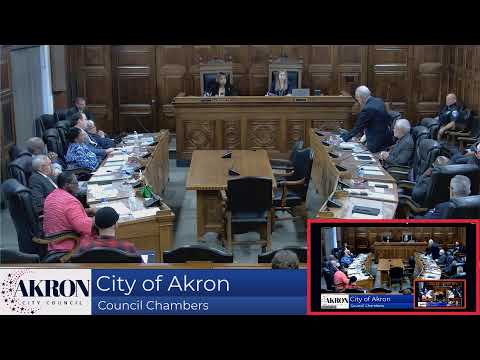
Akron City Council voted to declare it necessary to improve Home Avenue, passing a resolution after debate about the project’s design and traffic impacts.
Councilman Anthony Lombardo pulled the item from the consent agenda and told colleagues he opposed the plan’s design. "I just didn't agree with the design of the plan for Home Avenue," Lombardo said, explaining he pulled it so the council could discuss neighborhood impacts. City staff later put the total project cost at about $2,600,000 and said approximately $1,700,000 of that comes from the Ohio Public Works Commission (OPWC). A city staff member warned that if the council declined the project the OPWC dollars would likely be forfeited and reallocated through the state's competitive process.
Council members debated whether the design — which includes lane reductions consistent with the city's 'direct street design' approach — would cause congestion and cut lanes in some neighborhoods. Councilwoman Linda Amobian, who said she represents the whole city, acknowledged earlier concerns raised for similar projects and noted the council previously approved the direct-street design approach to slow traffic and encourage walkable streets. "That is what we voted for," she said, while also urging sensitivity to neighborhood impacts.
After the discussion the council moved to suspend the rules and vote. The resolution passed by roll call, 11–1, with Lombardo recorded as the lone no vote.
What’s next: The resolution declares an emergency and advances the project to implementation planning; city staff said losing the OPWC grant would likely mean the money is reallocated to another community through the state's application process.