Lifetime Citizen Portal Access — AI Briefings, Alerts & Unlimited Follows
Council members and advocates press for measurable goals, aviation changes and funding detail in 2025 Strategic Climate Action Plan
Loading...
Summary
Public commenters and council staff debated the 2025 SCAP’s treatment of aviation emissions, tree canopy goals, point-of-sale energy measures and funding. Staff said 177 actions and 64 performance measures are proposed, 126 of which need new funding; the committee held the SCAP and requested striking amendments and additional reporting.
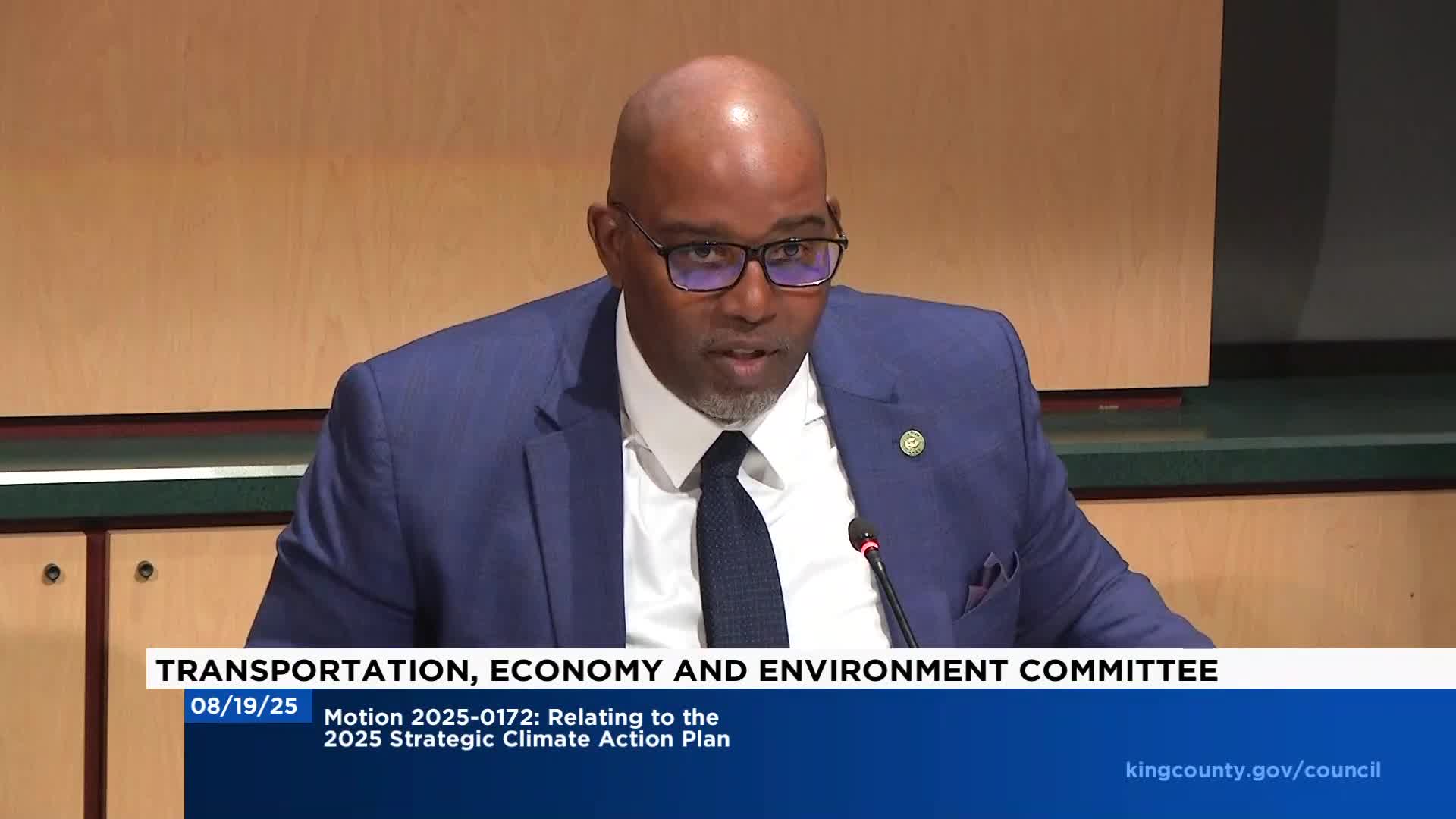
Public testimony and council discussion on Aug. 19 focused heavily on the 2025 Strategic Climate Action Plan’s (SCAP) treatment of aviation emissions, tree canopy goals, measurement and funding.
Jake Tracy, council staff, briefed the committee on SCAP’s structure: a five-year plan with 25 focus areas, 177 proposed actions and 64 performance measures. Tracy told members that 126 of the 177 actions will need new or additional funding and that executive staff expect to identify rough funding figures within a year of adoption. He also said the plan’s wedge graph projects about a 35% countywide emissions reduction by 2030 under the assumed mix of local, state and federal actions — short of the county’s Comprehensive Plan targets.
Speakers from environmental and community groups repeatedly urged stronger, measurable commitments. Maria Batiola of the Aviation Community Health, Environment and Climate Advocates Coalition emphasized aviation’s local health impacts and urged a joint community–scientific–technical task force on aviation mitigation. Multiple volunteer members of the Joint Aircraft Emissions Technical and Community Task Force told the committee they believed the SCAP omitted task-force recommendations or elevated sustainable aviation fuels in ways the task force did not endorse. "It is disingenuous ... to ask community volunteers to work so hard on something that is then ignored," Laura Gibbons of 350 Seattle said.
Council staff walked members through highlighted actions that will be the subject of proposed amendments. Notable items discussed included:
- Aviation (Action GHG23): The SCAP would support sustainable aviation fuel and zero-emission aviation technology, advocate for Cascadia rail and expanded Amtrak service, and seek to phase out leaded aviation fuel at King County International Airport (KCIA) by 2030. Staff noted the plan includes mitigation funding measures (for indoor air quality retrofits and tree canopy where FAA rules allow) and acknowledged that sustainable aviation fuel was not a Task Force recommendation.
- Residential point-of-sale program (Action GHG26): The plan describes a disclosure requirement and a possible performance-standard program that could require efficiency upgrades at the time of sale; staff said the county has limited authority (primarily in unincorporated areas) and that code changes and more code-enforcement resources would be needed for a mandatory program.
- Transit funding and MetroConnects (Action GHG15): Staff said MetroConnects’ long-range plan estimates an $18 billion capital gap and about $724 million per year in service costs; the SCAP action would develop a funding strategy and explore a regional ballot measure, but councilmembers discussed whether language should be softened to "explore" rather than commit.
- Tree canopy and measurable goals: Multiple commenters pressed for a measurable tree canopy target (for example, a 40% urban canopy goal was cited by a public speaker) and for a community-led toolkit and work plan to measure and track canopy gains.
Council members repeatedly emphasized accountability and measurement. Councilmember Balducci and others said, "If you can't measure it, you can't achieve it," and urged that outcome measures (for example, greenhouse gas reductions, heat-related emergency visits, and particulate-matter exposure indicators) be included and tracked publicly. Chair Quinn said he will direct staff to prepare a striking amendment and asked colleagues to submit amendment requests by Aug. 22; the committee will hold the item for a September special meeting.
Staff also noted interactions with other planning efforts: SCAP will draw on functional plans such as the 30-year Forest Plan and Flood Management Plan, but is intended to highlight actions for the next five years. Executive staff told the committee they plan to identify which SCAP actions require code updates and expect an implementation work plan within six months of adoption.
Next steps: The committee held the SCAP in committee, requested a striking amendment and additional reporting (including funding and a code-work plan), and scheduled continued consideration at the September special meeting.