Get Full Government Meeting Transcripts, Videos, & Alerts Forever!
Get email alerts on the Judicial Pay topic
No spam. Unsubscribe anytime.
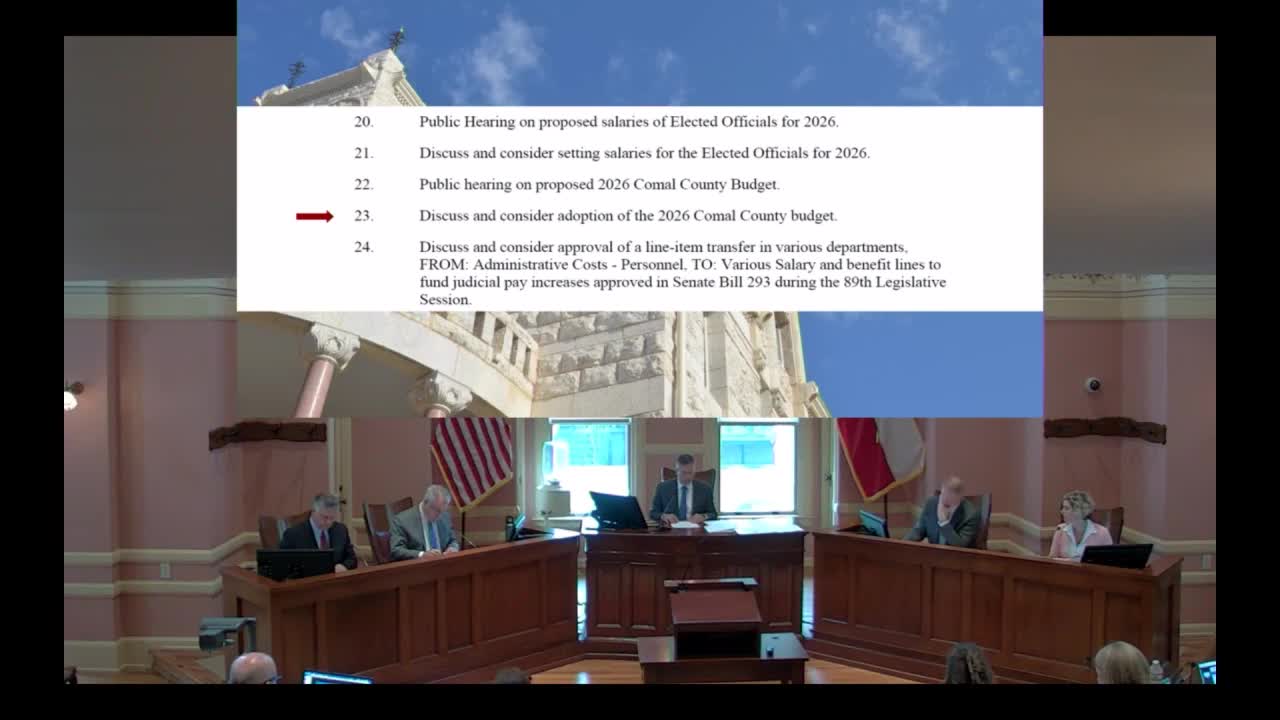
Comal County approves line-item transfers to cover judicial pay increases; judges urge alternative distribution methods
Summary
The court approved transfers to fund judicial pay increases tied to a recent state change (Senate Bill 293). Several district judges told the court population-based splits under discussion do not reflect how they schedule and divide their time among counties.
Comal County Commissioners on Aug. 21 approved a line-item transfer to fund increases in judicial pay that become effective Sept. 1 under a state legislative change (referenced in the transcript as Senate Bill 293). County staff explained the supplement calculations and recommended sharing costs with neighboring counties for judges who serve multiple counties.
Several district judges addressed the court during the item and urged a different approach to dividing supplements. Judge Gary Steele told commissioners he spends more than a third of his time in Comal County and that dividing supplements strictly by population percentages "is misleading" and could send the wrong signal about where judges should schedule court. Judge Waldrop and other judges described scheduling and caseload practices that they said do not track precisely with population percentages.
County staff explained they used available guidance and a population-percentage formula to allocate the county's share for the remainder of 2025, and that the built numbers in the proposal reflect estimated fringe costs. The presiding judge said he would abstain from voting on the item because it affects his salary; the abstention was recorded in the transcript. The court voted to approve the line-item transfer and related supplement increases for the remainder of 2025 to move the county into compliance with the statutory changes.
Next steps: The county will implement the approved transfers for the remainder of 2025 and staff said they will continue to work with neighboring counties and the Office of Court Administration to refine allocations going forward.