Get Full Government Meeting Transcripts, Videos, & Alerts Forever!
Get email alerts on the Enforcement topic
No spam. Unsubscribe anytime.
Neighbors, preservationists call for penalties and tighter oversight after illegal work at 2229 Webster
Summary
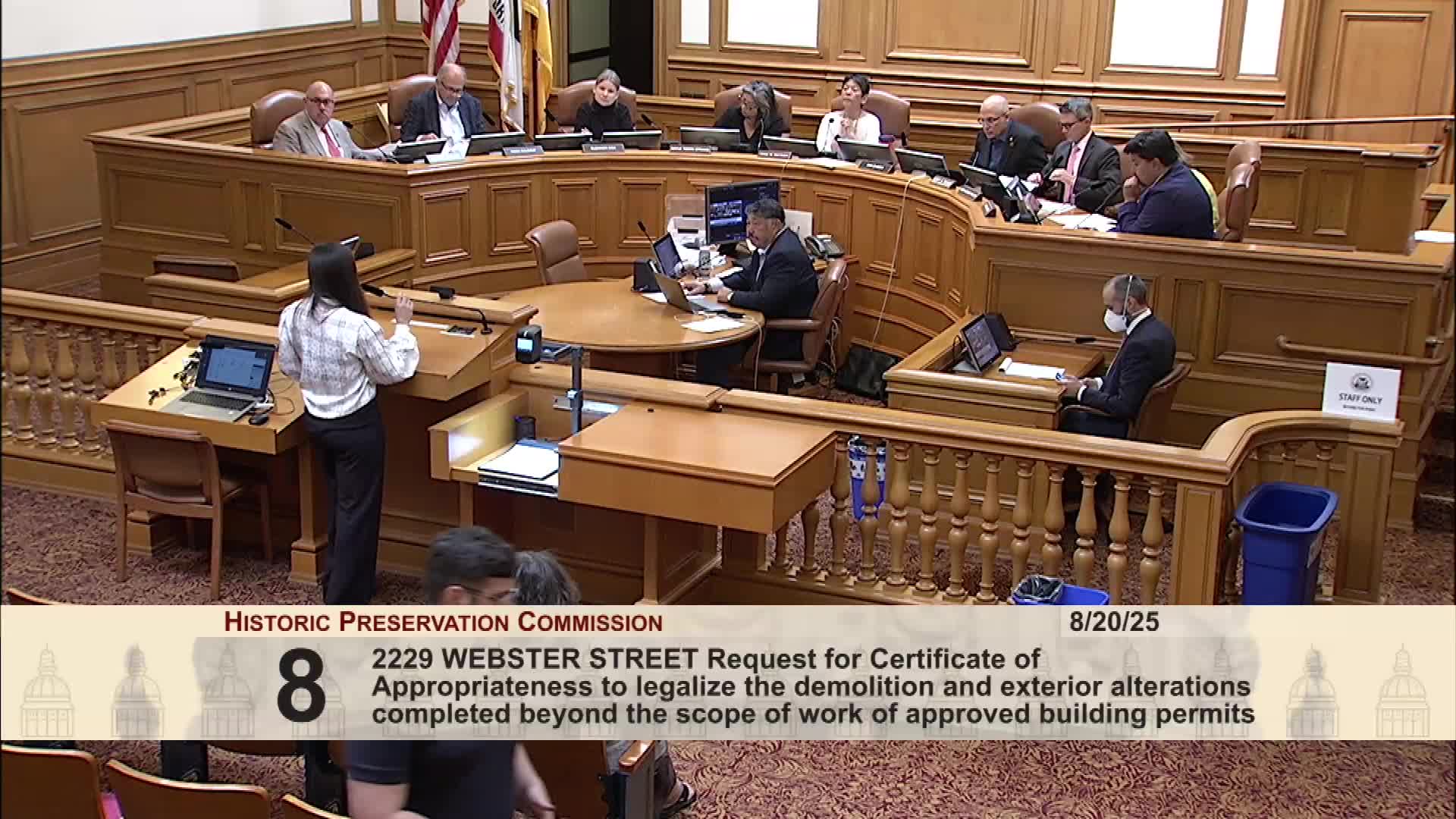
The Historic Preservation Commission heard extensive public concern and staff enforcement updates over large unpermitted alterations at 2229 Webster Street, continued the COA to Sept. 17 for a restoration plan, and signaled a separate zoning-administrator penalty review that could include a one-time fine up to $500,000.
The San Francisco Historic Preservation Commission on Aug. 20 advanced action on an enforcement case at 2229 Webster Street after weeks of controversy over unpermitted demolition and alterations to an Article 10 historic property.
Planning staff told commissioners the department's enforcement timeline began after an over-the-counter building permit was issued in June 2024 without a required Certificate of Appropriateness. A code-enforcement case opened in October 2024, the permit was later suspended, and the owner filed the COA application in March 2025 to legalize work done without entitlements.
Neighbors and preservation groups urged the commission to use the new enforcement authorities aggressively. Michael Dern said removal of a mature street tree and curb cut proposals harmed the streetscape and public parking; Woody Labonte, president and CEO of San Francisco Heritage, said the scale of demolition warranted strict action and argued against a lenient resolution. Ray Greenwell and others described salvaging a dozen original windows from what they said were contractor dumpsters and said city staff and the owner were negotiating restoration of those historic features.
Code enforcement manager Kelly Wong summarized the case history and told the commission staff had confirmed work exceeding the over-the-counter permit. Zoning administrator Teague explained a 2023 ordinance added punitive enforcement tools: a one-time penalty of up to $250,000 per dwelling unit added or removed and up to $500,000 for significant damage or demolition of historic resources. Teague said staff were reviewing whether this case meets the criteria for a one-time penalty and expected a decision in the coming weeks; that enforcement action is separate from the COA vote before the commission.
Commissioners pressed for clearer plans and stronger enforceable conditions if they allowed legalization. Several asked staff to require technical specifications, contractor qualifications, periodic progress reports, construction kickoff meetings, and photographic monitoring during work. Staff said those monitoring conditions (including monthly photo updates and periodic inspections) are commonly used and could be added to a COA if the commission approves.
Given the scope of disagreement and the need for a detailed abatement strategy, the commission unanimously moved to continue consideration of the COA to Sept. 17 so staff and the owner can produce a restoration strategy, updated plans, and clarifying documentation; the zoning-administrator's penalty determination will proceed on a separate enforcement timeline.