Get email alerts on the Tree Mitigation topic
No spam. Unsubscribe anytime.
Miami board reduces after‑the‑fact mango tree mitigation to a single native replacement
Summary
After hearing staff that code requires large replacement for a 20" DBH mango removed without a permit, the board granted conditional relief: the appellant must plant one 4" DBH Florida native tree (Florida Grade No.1) with a one‑year guarantee; the motion passed unanimously.
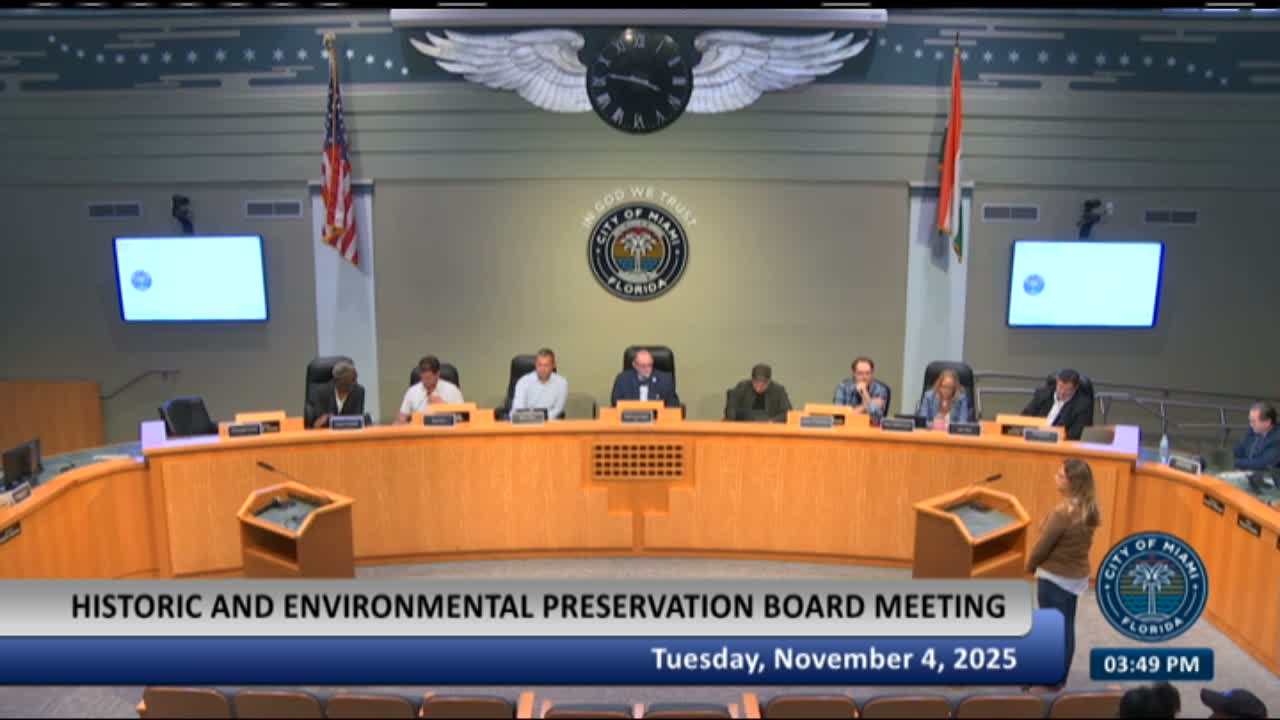
The Miami Historic and Environmental Preservation Board upheld an appeal of an after‑the‑fact tree removal permit for a 20‑inch diameter‑at‑breast‑height (DBH) mango tree at 224 Northwest 70 Fifth Street but imposed a limited replacement condition.
Environmental Resource staff presented the case and explained replacement obligations under the city’s Environmental Preservation Ordinance (chapter 17). For an after‑the‑fact removal of a 20" DBH tree on a non‑homestead property the code requires either 16 replacement trees at 2" DBH or 8 trees at 4" DBH, or, if planting is not feasible, a financial contribution to the city tree trust fund ($1,000 per 2" replacement tree). Staff recommended denial of the appeal on code grounds.
The property owner, Van Cole Simon, said the mango was dying and became a safety hazard after part of the tree fell in a wind event; he said he paid the $1,000 fine and sought relief from the full mitigation requirement. Board members and an ISA‑certified arborist on staff, Sean Smith, discussed whether photographic evidence or a high‑risk determination would have permitted removal without mitigation under code. Several members said the mitigation schedule reads as punitive in clear cases of hazard removal.
The board reached a compromise: it upheld the appeal but required the appellant to plant a single Florida native tree (4" DBH, minimum 16' height, Florida Grade No. 1) on the property, submit a simple (hand‑sketch) planting plan for staff approval, and warranty the planting for one year. The motion carried unanimously (9‑0).
Why it matters: The case highlights tension between strict replacement formulas intended to protect canopy and on‑the‑ground safety or practical limitations on small urban lots. The board used its discretion to obtain new canopy on site while avoiding what members called an onerous replacement burden for a family property that already contained substantial tree cover.
What’s next: The appellant must submit planting documentation and a sketch plan for staff approval and ensure the installed tree meets Florida Grade No.1 standards and a one‑year survival guarantee. If the property owner cannot comply, the city’s tree trust fund payment provisions remain available under code.
AI generated
The text on this page is AI generated. Summaries, highlights, analysis, and video transcripts are all produced from the original source material.
AI can make mistakes, so if you spot one, and we will fix it for everyone.
Note: the source content is unaltered by us. Any content source we link to, be it a video, an audio recording, or a document, is presented exactly as its publisher released it. That publisher is usually a government body, sometimes an individual official or another organisation.