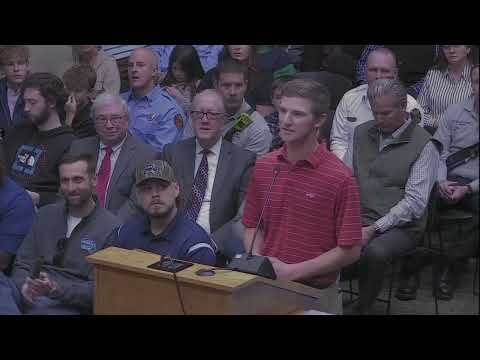
Bowling Green advances first reading of stormwater utility with $4 monthly residential fee
Loading...
Summary
At a Nov. 4 Board of Commissioners meeting, staff presented Ordinance BG2025-26 to create a stormwater utility using an equivalent residential unit (ERU) approach; residential customers would pay $4 per month ($48/year), with fees not collected until Jan. 1, 2027. Commissioners pressed staff on discounts and billing logistics.
Bowling Green commissioners on Nov. 4 advanced a first reading of Ordinance BG2025-26, a proposal to establish a municipal stormwater utility that would levy a $4 monthly fee on residential dwellings to fund drainage and stormwater infrastructure improvements.
City staff and consultants said the proposal uses an equivalent residential unit (ERU) methodology to measure impervious surface and to set commercial charges. Matt, the city’s stormwater lead, said the city identified the ERU as 4,200 square feet based on NV5 land-cover data and local analysis. "We will not collect any fees until 01/01/2027," Matt said, describing a phased implementation that gives staff time to develop billing credits and administrative procedures.
The ordinance package includes two main components: a stormwater utility fee (the residential $4/month proposal) and a fee-in-lieu-of-construction option for developers who prefer to pay into the fund rather than build certain on‑site stormwater controls. Staff said minor code edits and updated standards would become effective at second reading, while the fee itself would not be billed for more than a year.
Commissioners and staff discussed discount options and administrative costs. Staff reviewed alternatives used in other Kentucky cities — e.g., tiered rates, half‑ERU exemptions, and senior/low‑income discounts — and said most options either would reach only a small number of parcels or would create heavy administrative overhead. Matt said a 50% discount is the largest commonly seen and that administering targeted discounts at scale would require two to three additional full‑time staff members.
Several commissioners asked how the fee would appear on utility bills and whether the city would contract with existing billing partners. Matt said the city expects to pursue interlocal agreements for collection but has not finalized the billing mechanism and noted that collection fees could reduce net revenue. Staff also said the county has run a similar $4 residential program since about 2007 and that the city’s residential rate aligns with that structure.
On the question of first‑year revenue and project lists, staff said estimates remained preliminary and asked to present refined numbers at second reading once final calculations are reviewed by finance staff. After debate, commissioners voted to advance the ordinance on first reading (nonbinding), with staff agreeing to return with updated revenue projections and implementation details at the next hearing.
Next steps: staff will refine the financial model, develop billing and credit policies, and present a second reading with updated revenue estimates and any recommended discount or collection policies.