Get Full Government Meeting Transcripts, Videos, & Alerts Forever!
Get email alerts on the Housing Affordable Development topic
No spam. Unsubscribe anytime.
Ohio Housing Finance Agency reports record lending and strong LIHTC demand in FY25
Summary
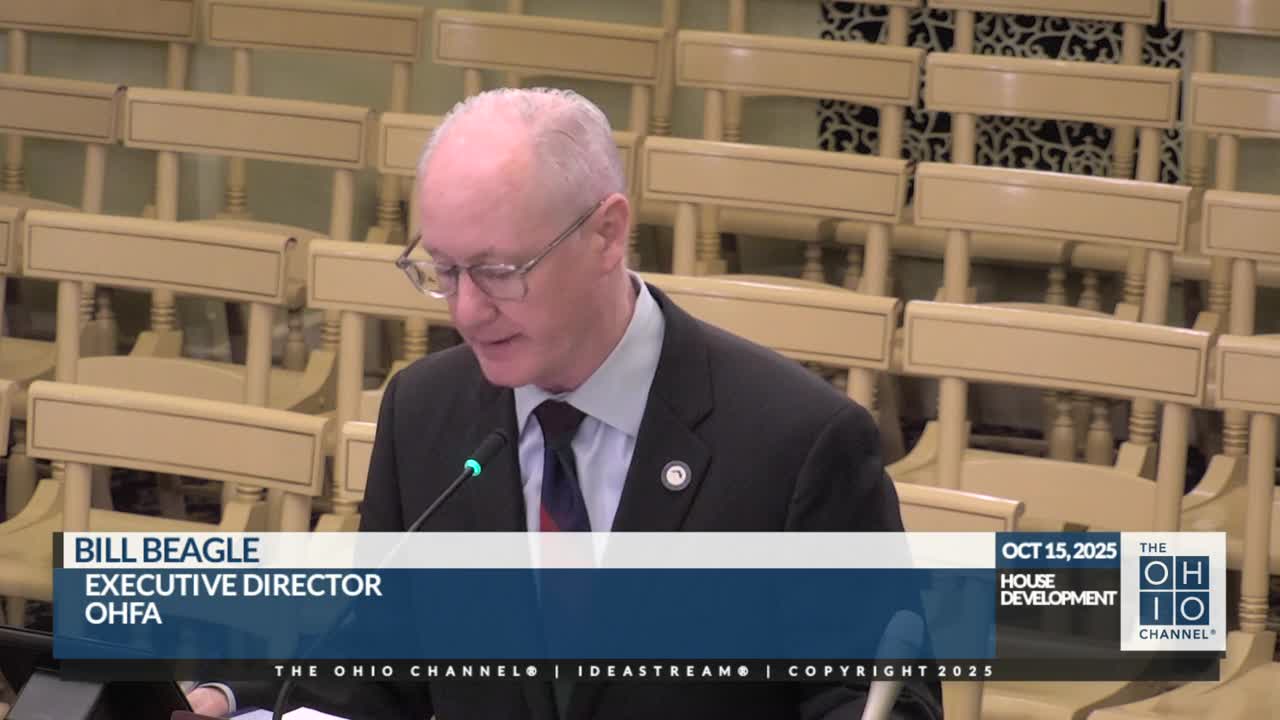
Director Bill Beagle told the House Development Committee OFA financed $1.3 billion in homebuyer loans in FY25 (up from $813 million in FY24), allocated $1.2 billion for 8,183 affordable units through LIHTC, and adjusted down-payment assistance starting 07/01/2025 to preserve program capacity.
Bill Beagle, executive director of the Ohio Housing Finance Agency, presented the agency's 2025 annual report to the House Development Committee and highlighted record homebuyer lending, high demand for tax credits and OFA compliance work.
Beagle said OFA financed about $1.3 billion in homebuyer loans in fiscal year 2025, up from $813 million in FY24. He also said OFA adjusted its down-payment assistance program effective July 1, 2025, moving to 3% for conventional loans and 3.5% for government loans to preserve program capacity amid higher loan volume.
On rental housing, Beagle reported OFA allocated $1.2 billion in FY25 for the creation or preservation of 8,183 affordable housing units through low-income housing tax credit (LIHTC) programs; the state LIHTC was used in 13 developments. He said LIHTC programs remain oversubscribed, with demand exceeding available credits.
Beagle described program compliance and oversight: OFA conducted 406 physical inspections and 340 file reviews in FY25 and operates a help desk to assist residents and property managers. He noted OFAis a self-supporting agency, governed by a 15-member board under Chapter 175 of the Ohio Revised Code, and that the agency uses combinations of federal, state and other program dollars to make developments financially feasible.
Committee members asked about data behind the "single household" designation, outreach to rural areas and how Community Reinvestment Act credit flows to purchasers of tax credits; Beagle said OFA can provide more granular data and described outreach, allocation criteria, and occasional set-asides to reach low-volume rural counties such as Appalachia.