Get Full Government Meeting Transcripts, Videos, & Alerts Forever!
Get email alerts on the Public Safety Free Speech topic
No spam. Unsubscribe anytime.
Whittier adopts urgency ordinance banning targeted residential picketing within 300 feet of homes
Summary
The Whittier City Council on Sept. 9 adopted an urgency ordinance (No. 3169) prohibiting targeted residential picketing within 300 feet of a dwelling, citing resident safety and privacy; the measure passed 5–0 and staff also introduced a standard ordinance (No. 3170) to follow regular adoption procedures.
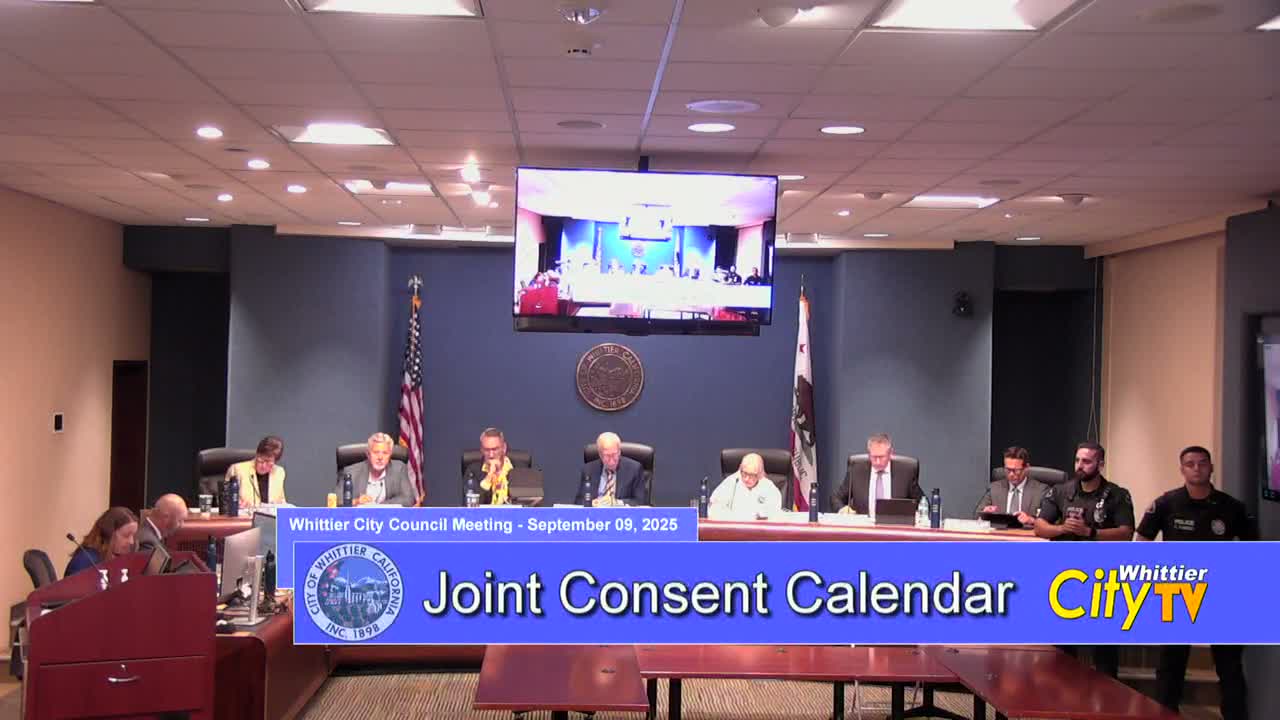
The Whittier City Council voted unanimously Sept. 9 to adopt an urgency ordinance (No. 3169) that would prohibit “targeted residential picketing” within 300 feet of a residential structure and to introduce an identical standard ordinance (No. 3170).
City staff framed the ordinances as an effort to protect the “well-being, tranquility, and privacy of the home” while acknowledging that public demonstrations remain generally protected under the First Amendment. "The proposed urgency and standard ordinances would prohibit targeted picketing within 300 feet of a residential structure," staff told the council during the presentation.
Council members asked how the ordinance would be enforced and who it would protect. The city attorney said the ordinance is written to protect all residents — not only officials or staff — and described the typical enforcement mechanisms as civil and criminal penalties available for ordinance violations. "The law is designed to protect privacy and safety inside the home," the city attorney said.
Several members of the public opposed the proposed ordinance during an extended public-comment period, arguing it would chill protest activity and potentially violate state or federal free-speech guarantees. "This proposed ordinance is another more serious attempt at squashing free speech," one speaker said. Other residents urged protection for employees who said they had received threats or had their home addresses posted to encourage protests.
Council member Kathy Warner moved approval of the urgency measure and first reading of the standard ordinance; a second was made and the roll-call vote was 5–0 in favor. Because the council adopted the measure as an urgency ordinance, it goes into effect immediately; staff also introduced the identical standard ordinance to ensure continuity if a court later invalidates the urgency finding.
City staff said similar targeted-picketing measures have been adopted elsewhere and that at least one judicial decision has upheld a residential picketing restriction. Staff noted the ordinance is modeled on language challenged and upheld in California jurisdictions and explained the dual-ordinance approach — urgency plus standard — is a common municipal practice.
What happens next: staff will return the standard ordinance for a second reading as required by local procedure. Any legal challenge to the urgency finding would be decided by a court; if the urgency ordinance were overturned, the non-urgency ordinance (if later adopted) would be the standing local law.
Vote: Urgency ordinance No. 3169 adopted by roll call, 5–0. Introduced: ordinance No. 3170.