Get Full Government Meeting Transcripts, Videos, & Alerts Forever!
Get email alerts on the Property Taxes topic
No spam. Unsubscribe anytime.
Yuma County approves FY2026 tax levy; county says rates unchanged
Summary
The board approved the FY2026 property tax rates and levy summary (total levy $196,623,227; a 6.51% increase from the prior year) and staff emphasized the county did not raise its primary or secondary tax rates—the levy rose due to valuation growth and some taxing authorities’ decisions.
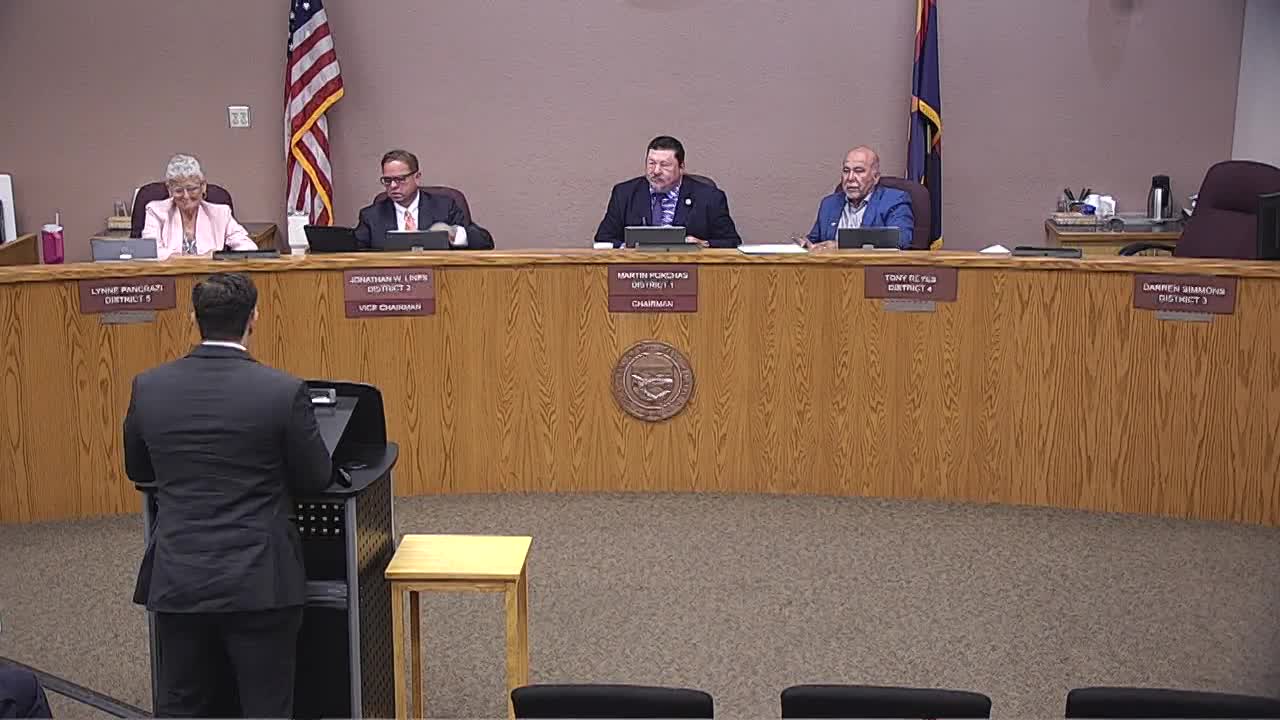
Yuma County Chief Financial Officer Humberto Del Castillo recommended approval of the FY2026 property tax rates and levy summary report during the Board of Supervisors meeting on Aug. 18.
Del Castillo reported the combined primary and secondary levy totals $196,623,227, an increase of $9,268,191 (6.51%) from the prior year. “I would also like to emphasize that this does not mean that tax rates... went up. Yuma County did not increase its primary or secondary tax rates,” Del Castillo said, explaining the levy increase is primarily driven by valuation growth from new construction and higher net assessed values; he also noted some taxing authorities adopted their own increases.
Del Castillo cited Arizona Revised Statutes 42‑17151 and 42‑17155 as the procedural basis for compiling and approving the report and for posting the county property tax worksheet online. He said the county coordinated with municipal and school officials, the assessor, treasurer and superintendent to verify submitted levies.
Following board discussion and a motion to approve, supervisors voted to adopt the FY2026 rates and levy summary and authorized transmittal of the worksheet to the treasurer’s office and the Arizona Department of Revenue’s Property Tax Oversight Committee for compliance review.
Board members used the discussion to reiterate the importance of public education about how multiple improvement and special districts affect individual tax bills, noting the county primarily acts as the messenger for levies adopted by other jurisdictions.