Get Full Government Meeting Transcripts, Videos, & Alerts Forever!
Get email alerts on the Broadband topic
No spam. Unsubscribe anytime.
Yuma County details $35M‑plus broadband build and 34‑tower ag wireless plan
Summary
Deputy County Administrator Josh Scott updated supervisors on a three‑phase middle‑mile dark fiber project (nearly 169 miles planned) funded with county ARPA and a $10M ACA grant, and a $6M‑backed 34‑site agricultural wireless network to support autonomous equipment and water management.
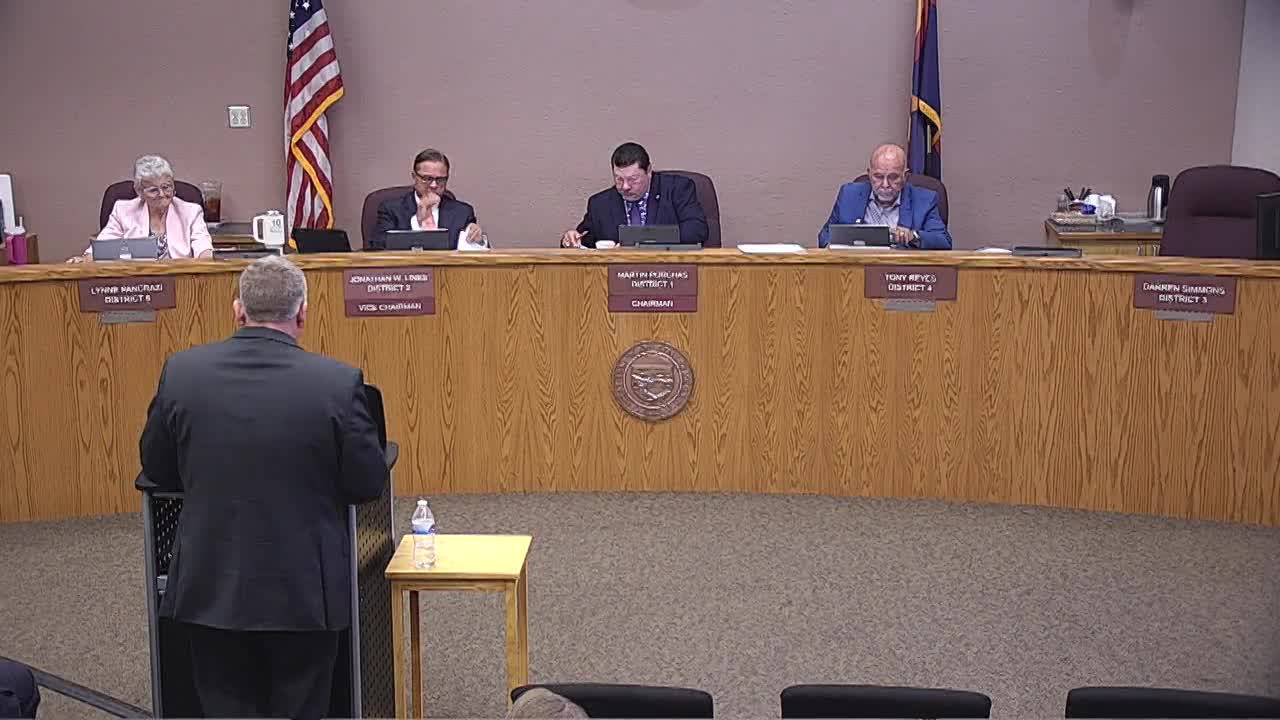
Deputy County Administrator Josh Scott told the Yuma County Board of Supervisors on Aug. 18 that the county’s broadband program is moving forward with a three‑phase middle‑mile fiber build and a parallel agricultural wireless network.
Scott said the county has committed $18,700,000 in American Rescue Plan Act funds and secured a $10,000,000 grant from the Arizona Commerce Authority for the fiber project, and estimated Phase 1 and Phase 2 together cost about $12,300,000. “This project entails installing dark fiber throughout the county with the express goal of lowering barriers to entry for service providers,” Scott said, describing a redundant, all‑underground design built with 144–288 fiber bundles and an empty conduit for future capacity.
The board was told Phase 2 is about 92% complete but one permitting segment along Highway 95 is delaying full connectivity; the Foothills portion is live and can be lit, Scott said. Phase 3 would add roughly 30 miles of dark fiber to reach agricultural areas and is currently estimated at about $5,300,000, bringing the total to just shy of 169 miles across all phases.
Scott also reviewed a county‑led agricultural wireless project supported by a $6,000,000 grant from the governor’s ARPA allocation. The plan calls for 34 monopoles (about 50 feet tall), with power and fiber at each site to allow multiple providers to deploy radios and antennas. “The idea is to bring broadband to the farm to allow them to better manage their operations and their water,” Scott told the board, noting the infrastructure is designed to support autonomous tractors, drones, soil moisture sensors and automated irrigation gates.
Board members and staff asked about permitting and right‑of‑way coordination with ADOT and federal land managers; Scott said one Highway 95 segment requires additional environmental clearances and permitting work and that the county anticipates closing out the ACA grant by June once construction is finished. The wireless deployment will begin in the field after permitting and power/fiber work and is expected to continue into next summer.
The county plans to return to the board Sept. 3 to consider a change order for Phase 3 work and to provide updated schedules and cost details.