Get Full Government Meeting Transcripts, Videos, & Alerts Forever!
Get email alerts on the Housing topic
No spam. Unsubscribe anytime.
Walker hears Kent County corridor housing strategy calling for infill, corridor prioritization
Summary
Housing Next presented a Kent County corridor strategy and urged Walker to prioritize underused corridors — Lake Michigan Drive, Leonard, Remembrance and possibly Wilson — to accommodate demand for 35,000 near-term and 70,000 long-term housing units while preserving greenfield land.
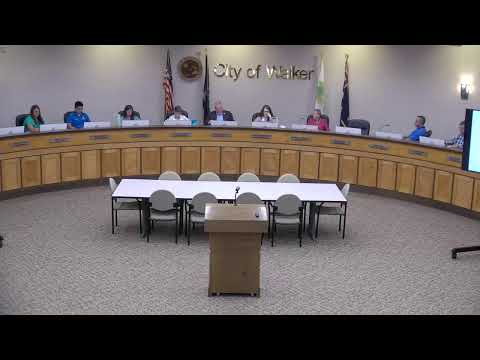
Ryan Kilpatrick, executive director of Housing Next, told the Walker City Commission on Aug. 11 that Kent County needs "about 35,000 additional housing units in Kent County over the next 5 years" and nearly "70,000 additional housing units by 2050." He said Housing Next and partner organizations, including the Grand Rapids Chamber, advocate using underutilized corridors and infill to meet that demand rather than expanding development onto farms and forests.
Kilpatrick said the group's analysis shows 98% of vacant, residentially zoned land in Kent County is restricted to single-family lots with average minimum lot sizes of about "1 and a half acres," which favors high-priced homes. He said that pattern leaves few options affordable to teachers, firefighters and other middle-income workers and that more compact, walkable neighborhoods would reduce per-household infrastructure costs.
"When you fill in those empty parking lots with buildings that produce tax revenue, we can show we're going from 27 households to 627 in the same 25 acres," Kilpatrick said, citing a Grand Rapids case study that he said increases taxable value from roughly $5.5 million to "$130,000,000." He framed that as a way to improve the tax revenue-to-infrastructure ratio without adding public infrastructure to each site.
Josh Langer of the Grand Rapids Chamber said the business community supports greater housing supply. "We represent 3,000 employers in Greater West Michigan, and a lot of them have said that availability and affordability of housing is really key" to economic growth, he said, and urged Walker leaders to identify corridors where the Chamber and private investors can help accelerate projects.
Commissioners discussed local corridor candidates. Kilpatrick identified Lake Michigan Drive, Leonard and Remembrance Road as primary corridors in Walker, and Commissioner Chase asked why Wilson south of Lake Michigan Drive was not included; Kilpatrick said the team would add Wilson if the commission wants that area evaluated and noted existing water infrastructure there. Mayor Carey and other commissioners agreed to form a working group with staff and elected officials to prioritize corridors and identify stakeholders.
The presenters asked the city to identify sites to evaluate and said Housing Next can assist with regulatory recommendations and developer financing strategies to make infill projects feasible.
Next steps: commissioners asked staff to form a working group and bring prioritized corridors and potential regulatory changes to the Planning Commission and City Commission for further consideration.