
Perry officials outline utility relocations and rising costs for Perry Lake dam work
Get AI-powered insights, summaries, and transcripts
Sign Up Free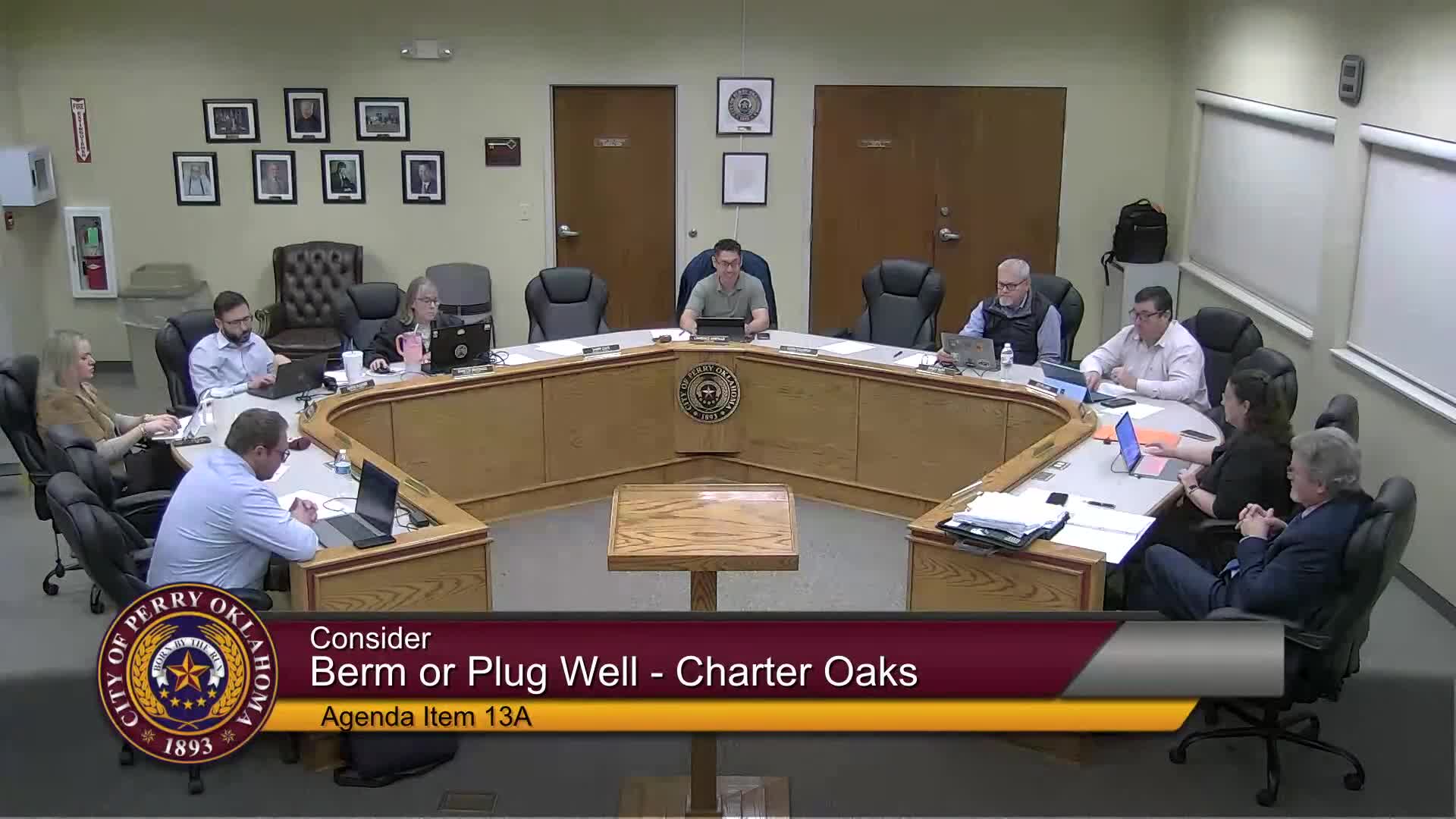
Summary
City of Perry staff and a consultant provided a high-level update on utility relocations tied to the Perry Lake dam project, highlighting a roughly $587,000 waterline relocation estimate and a $72,730 gas-line reroute proposal.
City of Perry staff and a consultant provided council members with a high-level update on utility moves tied to the Perry Lake dam rehabilitation, emphasizing sequencing, potential costs and funding uncertainty.
Consultant Matt said an oil well located in the future high-water area could be either plugged by its owner or protected with an earthen berm set to the top-of-dam elevation; staff said stakeholders are still deciding whether to plug the well or accept the cost of a berm to keep floodwaters away from the casing. “If they say no [to plugging], then we’ll look at constructing an earthen berm around it,” Matt said, summarizing options under discussion.
The most detailed cost figure presented was a waterline relocation estimate from a rural water district: $586,908 to install approximately one mile of 2-inch main, including engineering and inspection fees. Council discussed contingencies in the estimate and staff said the district would competitively bid the work with a not-to-exceed amount. Matt told the council he had expected a lower range (around $300,000–$400,000) but called the submitted estimate “better to shoot high and come in low.”
City Manager Mara and staff said sequencing the water-line relocation with dam construction could reduce costs, and that the Natural Resources Conservation Service (NRCS) had indicated some flexibility to sequence utility relocation with construction to save money. “NRCS would be satisfied if we at least had a utility relocation agreement in place because they’ve been willing to sequence the water line relocation with construction activities,” Matt said.
On the gas side, staff presented a proposal from Calvin May’s Oilfield Services to reroute a natural gas line for $72,730. The line presently leaves tank batteries on the dam’s south side and crosses the construction area; the contractor’s proposal would parallel the road with polyethylene pipe buried roughly 5 feet below finished grade. Staff and council noted the gas line is raw natural gas serving no homes and that costs for water and gas relocations may be mitigated if included in the prime construction contract.
No construction or utility relocation will begin before funding and relocation agreements are in place, officials said. Matt and staff said they will take the cost estimates back to NRCS and other potential funders for additional funding options; council members stressed the project’s long-term economic and recreational benefits for the community.
Next steps: staff will seek further clarification from NRCS and pursue competitive-bid language and relocation agreements to refine costs and funding commitments before mobilizing contractors.