Get Full Government Meeting Transcripts, Videos, & Alerts Forever!
Get email alerts on the State Of City topic
No spam. Unsubscribe anytime.
Sarasota mayor reviews recovery, housing and resilience in annual state-of-the-city
Summary
Mayor Liz Albert outlined the city’s recovery from recent hurricanes, reported roughly 1,000 affordable housing units in the pipeline, noted nearly $728.25 million in permit valuation year-to-date, and described resilience investments including Van Wezel Hall hardening and beach and dune restoration work.
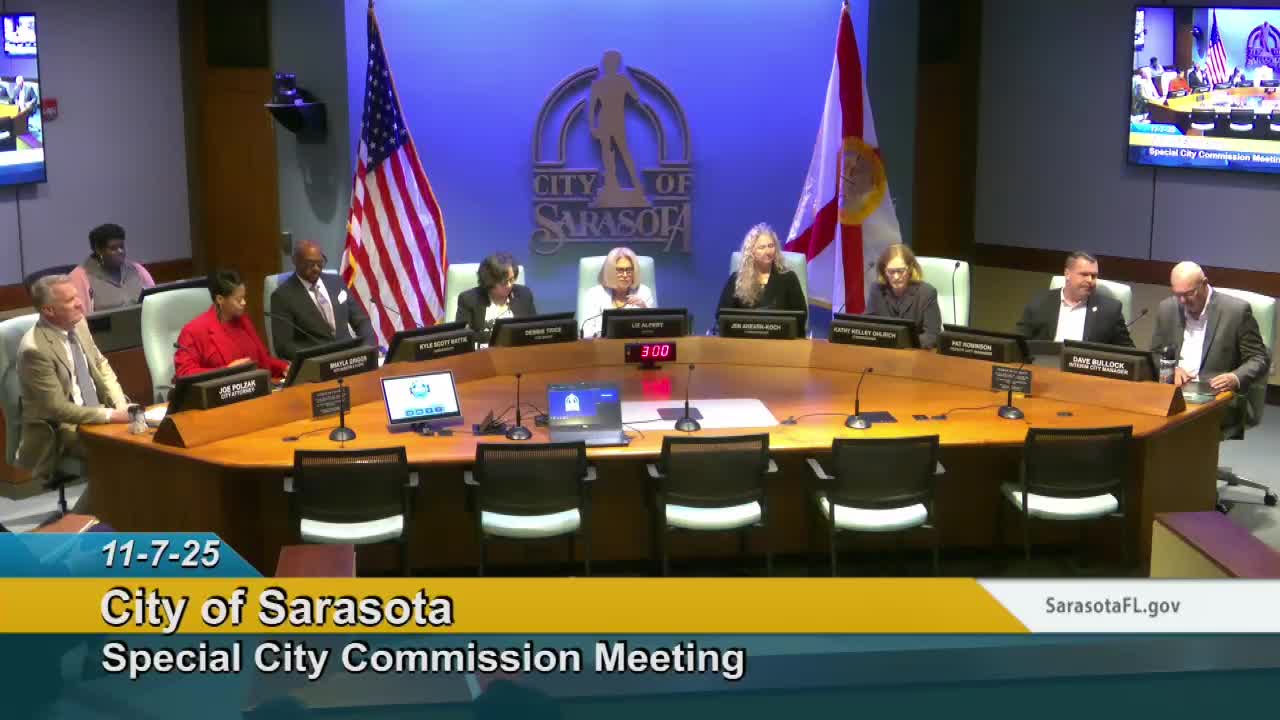
Mayor Liz Albert delivered Sarasota’s annual state-of-the-city address at the commission’s statutory meeting on Nov. 7, outlining recovery work after this year’s storms, progress on affordable housing and plans to strengthen the city’s shoreline and cultural facilities.
Albert said the city has revised allowable density in the Bayfront, downtown core and urban edge to encourage affordable housing and that "about a thousand units" are currently in the development pipeline. She said the city also has purchased property for an attainable-housing project across from City Hall and is seeking developer partners to deliver the project.
On finances, Albert said the city’s annual budget this year was roughly $2 million lower than last year’s while the millage was raised slightly to rebuild reserves that were drawn down by storm response. "We depleted our reserves about 80%" during hurricane cleanup, she said, and the millage increase was intended to restore those reserves.
Albert reviewed infrastructure and resilience projects that followed the storms. She cited an award-winning Ringling Boulevard and Pine Place roundabout, ongoing water-main replacements, a South Ashbury Avenue force-main sewer replacement already completed, and planned seawall upgrades and living shorelines. The mayor said the Van Wezel Performing Arts Hall — which sits close to the water and whose ground floor is below sea level — sustained heavy storm damage and has received a grant for flood‑proofing and hardening work to keep it operable for the next five to seven years while planning for a new center continues.
The mayor displayed recovery photos from parks and barrier islands, including St. Armands and Lido Beach, and gave an estimated parks-recovery cost of about $13.95 million. She said dune restoration and sand replacement work is scheduled to start in late 2025 with dune projects through 2026.
Albert also highlighted public-art programs, a legacy business initiative, transportation and micro‑mobility use (trolley, scooters and bikes), and a strong development-services workload: she cited 8,621 building permits issued and $728,247,309.49 in permit valuation year-to-date.
Why it matters: the address framed the commission’s priorities for 2026 — rebuilding reserves, continuing resilience investments and advancing affordable housing — and set expectations for hiring a permanent city manager and pursuing projects that tie recovery to long-term sustainability.
What’s next: the commission moved from the address to select a mayor and vice mayor for the coming year and to brief remarks by the newly named leaders.