
District iReady fall results show middle-school readiness near 40—250%; administrators stress multiple measures
Get AI-powered insights, summaries, and transcripts
Subscribe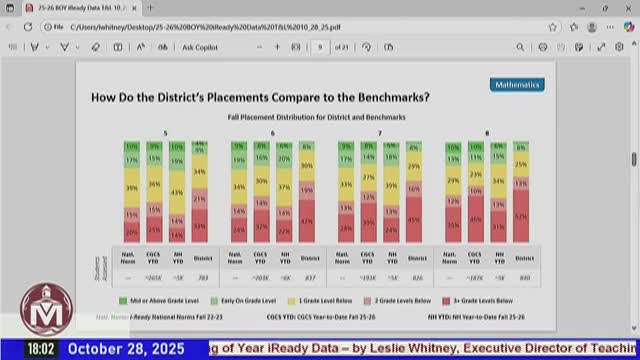
Summary
Leslie Whitney and district curriculum staff presented fall iReady diagnostics showing middle-school readiness around 40—250% for grade-level instruction, with current sixth grade an outlier tied to last year's fifth-grade transition; staff emphasized iReady is formative and will be used alongside PLCs, NSAS data and outcome-based contracting.
District curriculum director Leslie Whitney and colleagues presented the Manchester School District'wide fall iReady diagnostic to the Teaching & Learning Committee on Oct. 28, noting both growth pockets and areas for further attention.
Presenters said elementary schools show fewer students two or more grade levels below the Council of the Great City Schools benchmark, while middle-school readiness looks different: about 40% to 50% of middle-school students are ready to receive grade-level instruction at the beginning of the year, with current sixth grade identified as an outlier—attributed in part to the recent transition of fifth graders into the middle-school model.
"This slide shows that the Manchester elementary schools are showing less below proficiency compared to the Council of the Great City Schools," Whitney said. For middle school: "We see here that the students ready to receive their grade level instruction is approximately 40 to 50%... the current 6th grade data is the outlier."
District staff stressed iReady is one diagnostic among many. They described processes to drill down to domain levels (phonics, vocabulary, informational text) and to the teacher and student level so PLCs can target instruction. They also noted the district'level outcome-based contracting pilot will provide "clear, measurable results to guide targeted instruction" in participating schools.
Board members asked for clearer slide formatting and for district-produced visuals that place comparison bars side by side for easier interpretation. Members also asked for examples showing what "progress monitoring" and "curriculum standards work" mean in the classroom; staff said they will provide more concrete exemplars and that principals and assistant principals conduct classroom observations and data chats to monitor transfer of professional development to instruction.
Next steps: district staff will continue PLC analysis, monitor domain-level progress, and report follow-up dashboards and exemplars to the committee.