Get Full Government Meeting Transcripts, Videos, & Alerts Forever!
Get email alerts on the Capital Outlay topic
No spam. Unsubscribe anytime.
New Iberia accepts state capital outlay awards for streets, drainage and Sugar Cane Festival Building work
Summary
The City of New Iberia accepted three state capital outlay awards — roughly $500,000 for street planning, about $4.1 million (priority 5) for drainage planning and construction, and ~$3.2 million earmarked for improvements to the Sugar Cane Festival Building and parks — while noting the building transfer and match requirements remain unresolved.
The New Iberia City Council on Aug. 19 accepted multiple state capital outlay awards and designated a city representative to act on the grants. Resolution No. 2592 accepts $500,000 for street‑improvement planning and design; Resolution No. 2593 accepts roughly $4.1 million for drainage planning and construction (identified as priority 5 and intended to seed engineering work this year); and Resolution No. 2594 accepts approximately $3.2 million for building and park improvements, including funds scoped for the Sugar Cane Festival Building.
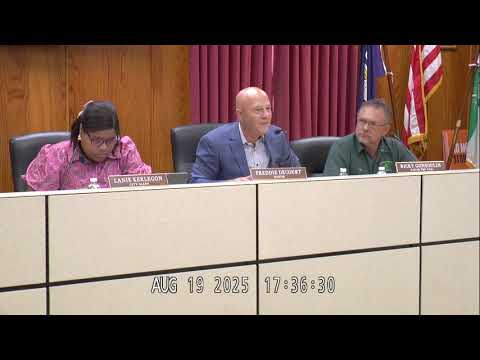
Mayor Frederick de Court told council members the $500,000 came through the governor’s office and local legislative delegations and will be used for engineering, change orders and preliminary work. For the drainage award the mayor noted the city expects additional grant dollars (a pending $3 million grant referenced during the meeting) and characterized the award as an opportunity to parlay planning dollars into larger construction funding next year.
On the Sugar Cane Festival Building — a historic structure the city does not yet own — the mayor gave an extended briefing: state funding is conditional on the building’s transfer to the city, phase‑1 work (mechanical systems, sprinkler repair, ventilation, fire‑alarm and safety upgrades and basement ventilation) could cost in the low millions, and full renovation and a modest addition could ultimately total $6–7 million. Council members asked to review phase‑1 plans and budgets once transfer is clear. The mayor said historic tax credits and the sale of tax credits could be explored to offset rehabilitation costs.
Each resolution was moved and seconded and then approved by the council; the transcript does not include a roll‑call vote tally. Councilmembers emphasized the awards address long‑standing drainage and facility maintenance needs, but noted the need to sequence engineering and permitting work and to resolve property‑transfer details before spending the Sugar Cane Festival Building funds.