Get Full Government Meeting Transcripts, Videos, & Alerts Forever!
Get email alerts on the Land Use Regulations topic
No spam. Unsubscribe anytime.
Cherokee County adopts tree‑preservation and sidewalk tolerance amendments to development rules
Summary
The Board adopted text amendments to Article 27 (tree preservation) and Section 4.15 (sidewalk grade tolerance), allowing prescriptive care plans for some specimen tree impacts and increasing allowable private-sidewalk cross-slope tolerance from 2% to 3.5%; both measures passed unanimously.
The Cherokee County Board of Commissioners on April 19 adopted two development-code changes intended to clarify tree protections and give greater field flexibility on private sidewalk construction.
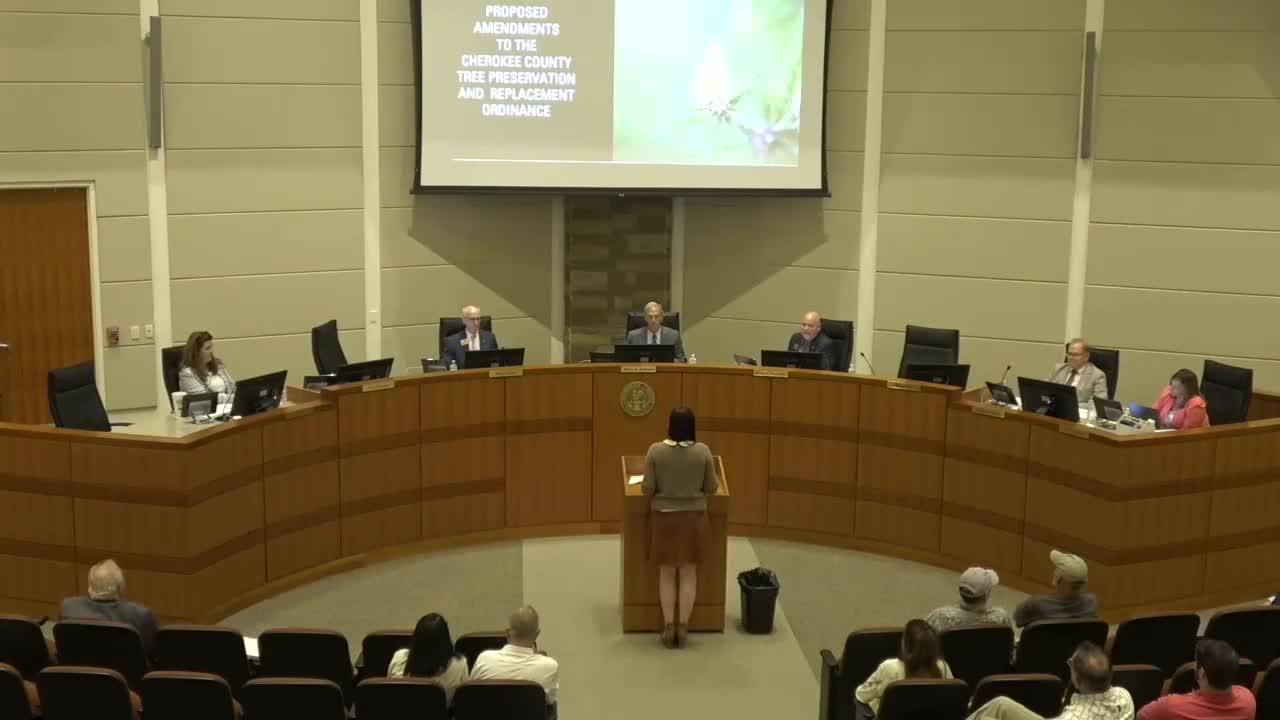
County arborist Shannon Fitzgerald told the board the Article 27 amendments add a minimum boundary‑tree size for regulatory review, reduce the critical‑root‑zone multiplier for boundary trees (for example converting a 30‑inch tree’s protected radius from 45 to 39 feet under the new factor), create a formal definition of “prescriptive care” (root pruning, targeted pesticide applications, soil aeration and similar measures) and allow prepaid prescriptive‑care plans in lieu of replanting for specimen‑tree impacts between 10% and 20%.
The board opened and closed a public hearing without public speakers and voted unanimously to adopt the tree ordinance amendments.
Separately, staff presented a proposed amendment to Section 4.15 of the development regulations to increase the allowable sidewalk cross‑slope on private streets from 2.0% to 3.5% under an administrative variance process. Brantley Day and Construction Inspector Chris Reid said the change is a field‑practical tolerance while the county prepares a Unified Development Code update over the next 12–15 months. The board opened and closed the public hearing on the sidewalk change and voted unanimously to adopt the amendment.
Both amendments were described by staff as technical and administrative updates: the tree changes add options to protect existing boundary trees, while the sidewalk change is intended to reduce unnecessary construction rejections for minor grade variances on private infrastructure.