Get email alerts on the Graduation Rate topic
No spam. Unsubscribe anytime.
MNPS reports second‑highest graduation rate but flags drop for Hispanic students
Summary
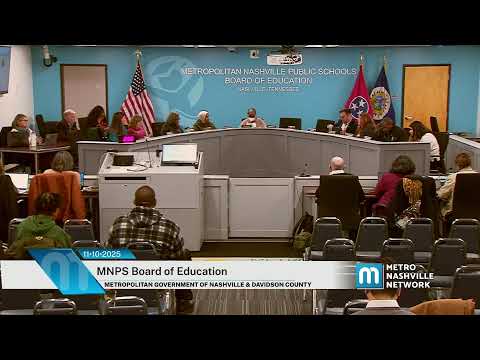
The Metropolitan Nashville Public Schools board received a graduation-rate briefing Tuesday noting the district achieved an overall graduation rate of 83.6%, the second-highest in MNPS history, and 271 more graduates in 2025 than in 2024.
The Metropolitan Nashville Public Schools board received a graduation-rate briefing Tuesday noting the district achieved an overall graduation rate of 83.6%, the second-highest in MNPS history, and 271 more graduates in 2025 than in 2024.
"We achieved the second highest overall graduation rate in our district's history," Director Dr. Battle said during the meeting, and Dr. Tina Stinson, executive officer for research, assessment and evaluation, walked board members through subgroup results.
Stinson highlighted significant gains for several groups: Black/African American students improved nearly six percentage points over the post-pandemic period; economically disadvantaged students rose about five points; students with disabilities recorded a 22‑percentage‑point gain from 2021 to 2025 (5.6 points of that in the most recent year); and Asian students reached 96.2% (up from 92.3). "We actually had 271 more graduates in 2025 than in 2024," Stinson said.
At the same time, the district reported a 6.1‑percentage‑point decline for Hispanic/Latino students. A student board member asked directly, "So how are we gonna combat the fact that we're losing, like, graduation rates specifically from the Hispanic population?" Dr. Stinson and district leaders said the district is actively studying the causes.
Staff and board members flagged a recent state policy change as a contributing factor. Stinson and other staff described a rule that shifts how students who leave the district are counted: if a student who transfers to another district is not enrolled and attending for at least 60 days in the receiving district, that student may be returned to the sending district's cohort and counted there. Stinson said that change increased the size of MNPS's cohort denominator this year, which can lower a district—s graduation-rate percentage even when the raw number of graduates rises.
"The numerator increased. The denominator increased more," Stinson said to explain how the district recorded more graduates but a slightly lower overall rate.
Board members and staff also pointed to local practices that have supported gains, including earlier cohort tracking (starting in ninth grade), continuous improvement cycles led by the exceptional education team, active casefinding for students missing credits, stronger monitoring systems, and partnerships with families and community organizations. Dr. Battle and staff credited leaders such as Debbie McAdams (director, Exceptional Education) and deputy chief David Williams for the work in special education that helped drive the gains.
Board members asked for additional analyses and follow-up. Staff said they would continue studying subgroup trends, document findings about the policy change, and bring further recommendations to the board.
Next steps: district staff told the board they will study the Hispanic/Latino decline, continue earlier cohort interventions, and report back with more detailed data and proposed strategies in future meetings.
AI generated
The text on this page is AI generated. Summaries, highlights, analysis, and video transcripts are all produced from the original source material.
AI can make mistakes, so if you spot one, and we will fix it for everyone.
Note: the source content is unaltered by us. Any content source we link to, be it a video, an audio recording, or a document, is presented exactly as its publisher released it. That publisher is usually a government body, sometimes an individual official or another organisation.