Get Full Government Meeting Transcripts, Videos, & Alerts Forever!
Get email alerts on the Transit Fare Policy topic
No spam. Unsubscribe anytime.
Honolulu council debates fare increases and widening low‑income eligibility; department warns of multimillion‑dollar revenue loss
Summary
Council members debated Bill 54’s proposed fare changes and competing amendments on Sept. 23, weighing an expanded low‑income threshold against projected revenue impacts and operational challenges for verifying discounts and personal care attendant waivers.
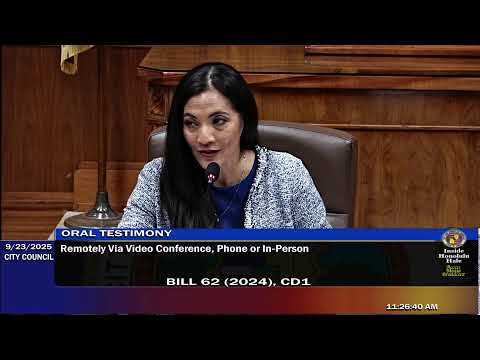
Council members on Sept. 23 discussed Bill 54, a proposed update to the fare structure for the multimodal municipal transportation system and several proposed amendments. Councilmember dos Santos Tam proposed widening the low‑income exemption from 30% area median income (AMI) to 50% AMI to reach more residents. "Right now the exemption is limited to those making 30% AMI and below ... my proposal would increase the threshold to 50% of area median income," dos Santos Tam said.
Roger Morton, director of the Department of Transportation Services, said the existing low‑income program is underutilized (about 4,500 certifications last year) while roughly 110,000 people would be eligible at the 30% threshold and an estimated 155,000–170,000 would be eligible at 50% AMI. Morton and department staff warned that expanding eligibility while keeping the current 95% discount for targeted groups could materially reduce passenger revenue—Morton estimated a potential $6–10 million annual revenue loss in one scenario.
The debate also addressed personal care attendant (PCA) fare waivers for riders with disabilities. Disability and Communication Access Board (DCAB) representative Brian Mick opposed proposed deletions that would remove PCAs from the fixed‑route fare waivers and urged that PCAs continue to ride free when accompanying a rider with a disability. Morton said administering a fixed‑route PCA certification would be difficult without a reliable way to verify who qualifies; he noted PCAs are accommodated on paratransit (Handyvan) where federal rules apply.
Public commenters raised other concerns: cash surcharges for single‑ride cash payments, outreach and enrollment for low‑income riders, and consultant costs for planning. Several testifiers urged the Council to preserve fare waivers and improve communication about low‑income programs.
After discussion, the chair amended the posted CD1 to a revised CD2 with several adjustments related to special events fares and other provisions and postponed final action to allow departments time to review the companion CD2 proposals and return to committee.
What happens next: the committee amended Bill 54 to a new CD2 and postponed further action to give DTS and other departments time to analyze the fiscal impacts and implementation issues (verification, PCA rules, open payments and HoloCard compatibility).