
Clark County monitoring shows hot summer temperatures and bacteria at urban sites; several areas improving
Get AI-powered insights, summaries, and transcripts
Subscribe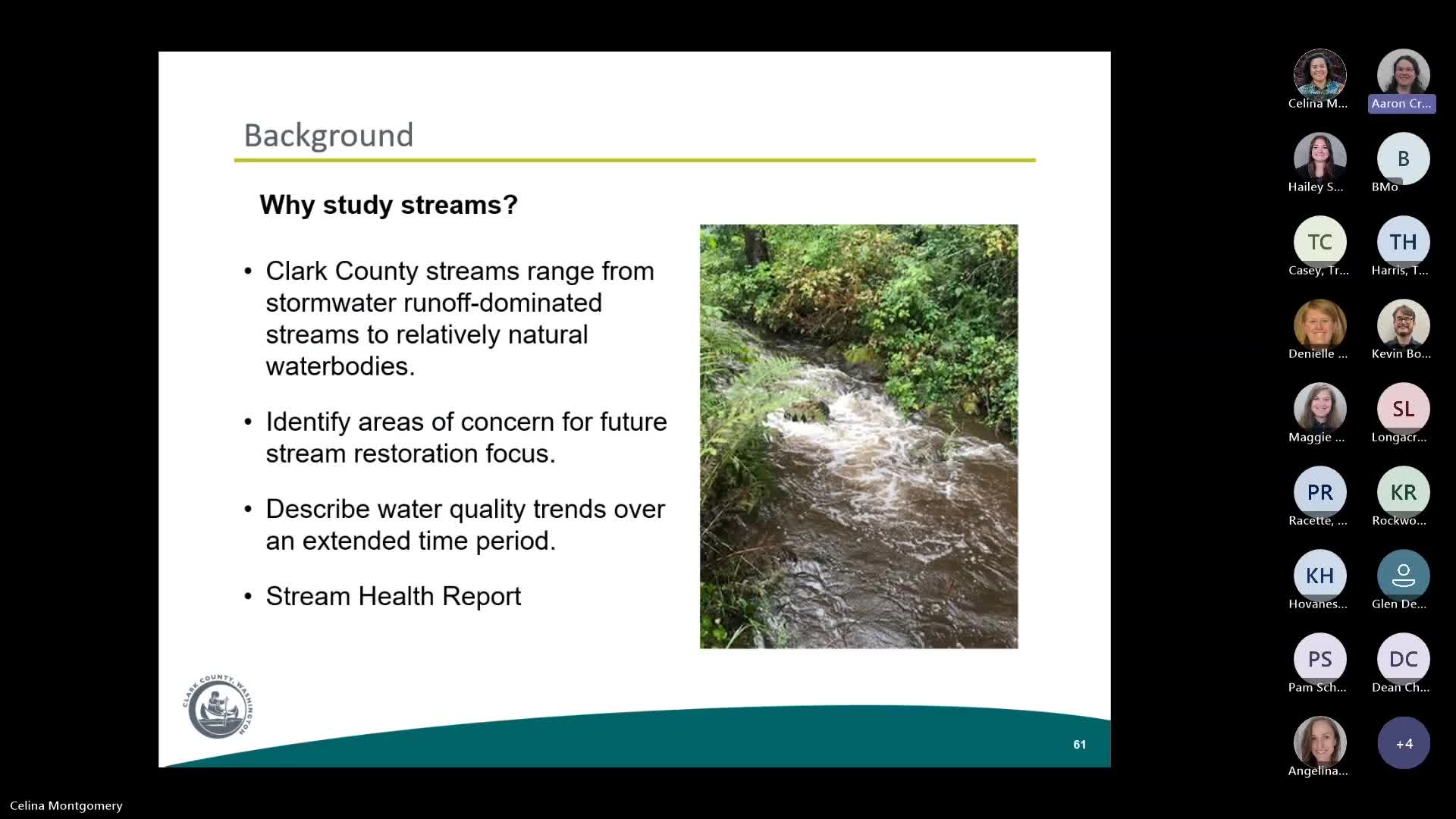
Summary
Clark County—s long-term monitoring program shows mixed stream-health trends: urban subwatersheds have higher bacteria and turbidity and several summer temperature readings exceed salmonid standards, while some subwatersheds show improvement since 2010. County staff described program methods, maps and local stormwater projects.
Marley Mosswich Butler, Clean Water special projects coordinator, reviewed Clark County—s monitoring network and methods: nine long-term index sites (monitored monthly), 42 rotating-panel sites on a five-year cycle, continuous temperature loggers and precipitation gauges. She said the county uses the Oregon Water Quality Index (OWQI), a benthic index (BIBI) and a TQ mean (flashiness metric) to summarize stream condition across water year 2024.
Marley reported that more urbanized subwatersheds exhibit higher bacteria and turbidity and that temperature maps show widespread summer exceedances of salmonid habitat criteria. "Temperature is an indicator for nonpoint thermal pollution due to lack of shade, riparian vegetation loss, hot surfaces when stormwater runs off," she said. She pointed to specific recent trend concerns (Mill Creek bacteria and Curtain Creek turbidity) and highlighted county capital projects (Heritage Farm wetland restoration; stormwater filters at Cougar Creek) and programs (maintenance, business source control, a developing stormwater management action plan) to reduce runoff impacts.
Why it matters: the monitoring data direct where restoration, BMPs and capital projects are prioritized and provide the evidence base for TMDL and Advanced Restoration Plan actions. Marley encouraged landowners and local governments to use the county—s interactive stream-health portal to examine site-level data and trends.
Next steps: continue rotating-panel monitoring, expand trend analysis, and implement targeted stormwater retrofits and riparian plantings in priority watersheds.