
Clark County planners say county must absorb 200,000 more people by 2045 while adding climate steps that affect water quality
Get AI-powered insights, summaries, and transcripts
Subscribe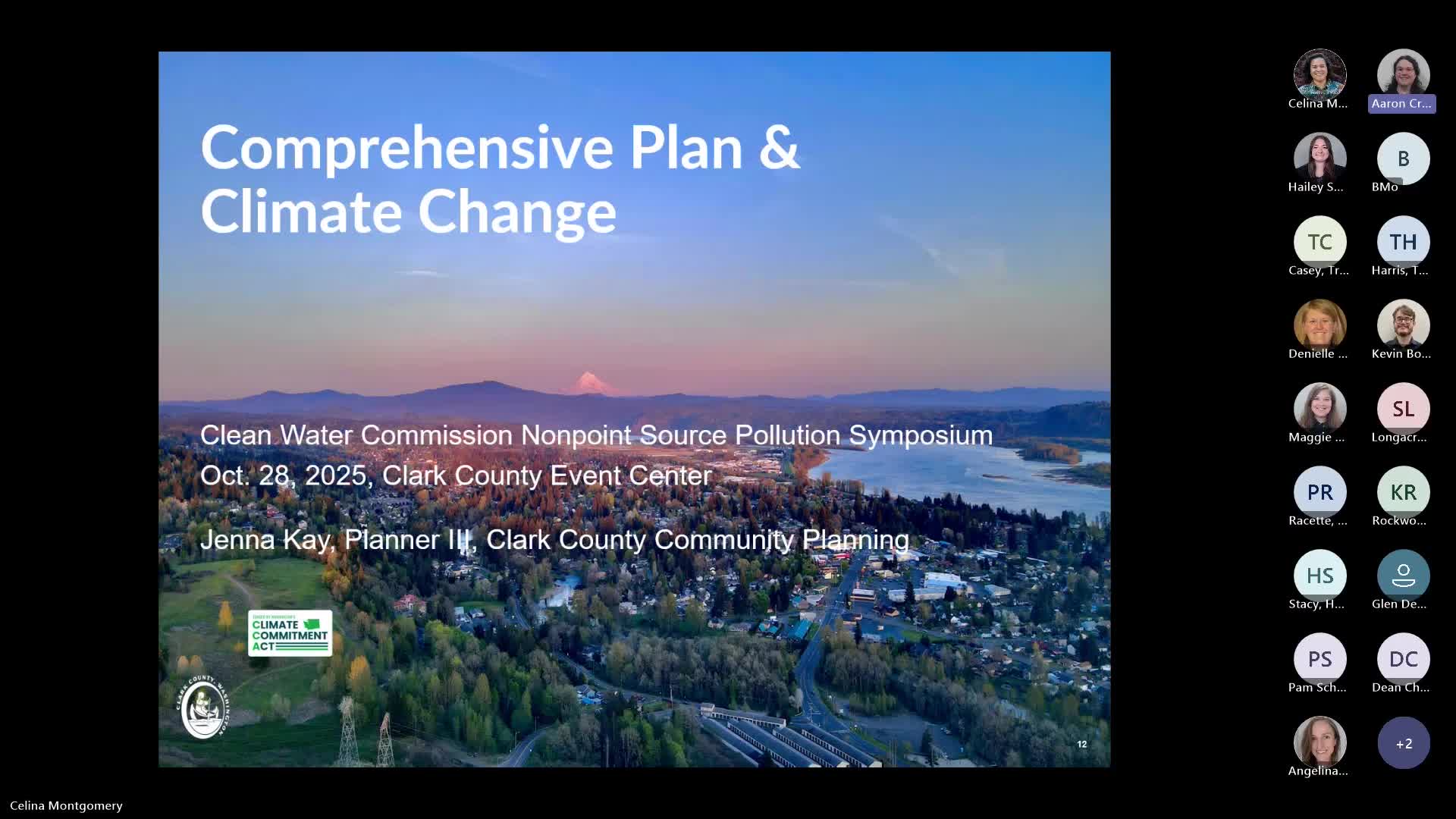
Summary
Clark County planners told a Clean Water Commission symposium that the county is planning for roughly 720,000 residents by 2045 (about 200,000 more than today) and must incorporate new state-mandated climate resilience and greenhouse-gas reduction policies that intersect with nonpoint source pollution and stormwater management.
Jenna Kaye, a long-range land-use planner for Clark County, told the Clean Water Commission symposium that the county—s current population estimate is "about 540,000 people" and that planning for 2025—2045 targets roughly 720,000 residents. She said state law requires coordinated comprehensive planning and that recent legislative changes make climate resilience and greenhouse-gas reduction mandatory parts of the county—s next plan.
Kaye summarized the county—s multi-phase 2025 plan update and said three land-use alternatives are under study in a draft environmental impact statement, with a public comment period noted on the county website. She described trade-offs officials must weigh: increasing density inside urban growth areas or expanding urban boundaries into rural land, both of which influence impervious surface, runoff and long-term stream health.
Kaye emphasized that the new climate requirements force the county to prioritize actions that reduce greenhouse gases while benefitting overburdened communities. "These actions must prioritize reductions that benefit overburdened communities to maximize the co-benefits of reduced air pollution and environmental justice," she said, explaining the county used state environmental-health disparity maps and community coalitions to shape draft policies.
Why it matters: land-use decisions shape how much impervious surface is built, where sewer and stormwater infrastructure is installed, and where riparian protections and tree canopy can slow stream heating and reduce sediment and bacteria loads. Kaye urged local officials and landowners attending the symposium to engage in the EIS comment process and follow the county—s schedule.
Next steps: countywide review and refinement of alternatives, forthcoming agricultural-land study, public open houses and a county council decision on a preferred alternative ahead of adoption of plan updates.