Get Full Government Meeting Transcripts, Videos, & Alerts Forever!
Get email alerts on the Land Use Development topic
No spam. Unsubscribe anytime.
Raymore staff outline hurdles and opportunities for GoodRanch Tract 1; developer talks set for December
Summary
City planning and economic development staff told the Raymore City Council that GoodRanch Tract 1 (about 141 acres) is zoned C-2/C-3, faces utility and MoDOT access constraints, carries an estimated land price of about $10/sq ft, and needs roughly $3.7 million in public infrastructure; a potentially viable developer will meet staff in December.
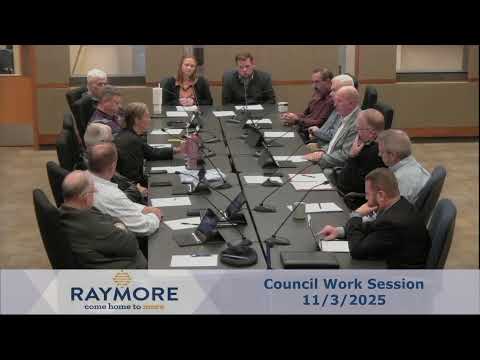
Raymore City planning and economic development staff told the City Council on Nov. 3 that GoodRanch Tract 1 — roughly 141 acres on North Cass Parkway — remains a high-potential but challenging site that needs a coordinated master plan, significant infrastructure investment and a market transaction between developer and landowner before formal proposals can advance.
"The cost of the land, based on some of our recent conversations, is about $10 per square foot," David Gress, a city planner, said during the council work session. Jordan Lee, economic development staff, said the city’s preliminary estimate for public infrastructure to make the site developable is "roughly 3,700,000.0," which does not include private utility work such as electric distribution or gas service.
Why it matters: The site’s size, split service boundaries and proximity to a state-controlled interchange make it one of Raymore’s most important long-term development opportunities, but those same factors raise the price of bringing it online. Staff warned that unless a realistic deal emerges among the landowner, a master developer and the city, the property is likely to see piecemeal, one-off proposals rather than a comprehensive mixed-use center.
Staff overview and constraints
Gress and Lee said the tract was annexed with the larger GoodRanch development and is zoned in two tiers: a C-2 (general commercial) district north of the Big Pond and C-3 (regional commercial) to the south. Ownership is held by Good Otis LLC, a partnership the staff described as representing the Good family and Otis interests; staff identified Dave Otis as the primary outside contact for development discussions.
Utilities and jurisdictional splits complicate planning. Staff pointed to a meter vault at Dean Avenue where the city sells water to Water District 10 under a settlement agreement; that split means portions of the tract would require coordination with the district for water service while sanitary sewer would come from the City of Raymore. Staff also noted pressure issues affecting a nearby user, Nuuly, as an example of the operational complexity.
Access to the site is governed in part by the Missouri Department of Transportation. "MoDOT typically...want[s] to see everything about this site, the uses, the traffic," Gress said, so the timing and design of intersections depend on traffic studies MoDOT will require before granting formal access approvals.
Market context and development strategy
Staff cited a comprehensive-plan retail market analysis estimating Raymore can support roughly 687,000 to 796,000 square feet of new retail through 2045, and said that Tract 1’s size means the city must avoid cannibalizing demand at other commercial sites. Jordan Lee and Gress said they lead marketing with potential anchor tenants and noted the tract could be developed as a mix of retail, service, professional/medical and possibly residential uses rather than 100% retail.
The city has used tools in the past — including transportation development districts and community improvement districts — to pay for major off-site work such as an interchange, but staff cautioned that Raymore does not have access to every financing tool used elsewhere and faces regional competition for projects and incentives, including packages available on the Kansas side of the metro.
Council concerns and owner incentives
Council members pressed staff on difficulty points: whether the reported per-acre price makes the tract uneconomic for many buyers, whether incentives should help the landowner or the developer, and how the city can avoid giving away long-term tax revenue. "It seems expensive to me," Mister Barber said after reviewing the staff materials. Mister Fearborn summarized consistent feedback staff has received: "The land price is really high," and several developers have told staff that price, coupled with on-site infrastructure needs, prevents deals from ‘penciling out.’
Staff said landowners have sometimes requested incentive dollars that would help pay the owner for the land, while developers say most money is needed for sub-surface utilities, grading and access work — an unresolved tension the council noted.
Next steps
City staff said the mayor, the development team and staff will meet with a developer they consider "viable and very interested" in December, and that a legitimate agreement between a developer and the landowner will be required before the city can expect a formal proposal. "We are certainly hoping for a breakthrough in December," Mr. Fearborn said.
No formal motions, votes or commitments of public funds were taken at the Nov. 3 work session. Staff told council members they will return with more-detailed master-plan materials and will report back after developer discussions.
Quotes in context
"The land price is really high," Mister Fearborn said, reflecting repeated developer feedback. "We are certainly hoping for a breakthrough in December," he added when describing an upcoming meeting with a prospective developer.
What’s not yet decided
Staff and council agreed that key unresolved items remain: whether the owner will accept price adjustments or terms amenable to a master developer, which financing tools (if any) Raymore can legally use for on-site or off-site work, and the traffic/access design MoDOT will approve after required studies.
Public-record details
Staff cited Good Otis LLC as the owner contact and noted an existing MOU covering annexation and broader Good Ranch development but not a Tract 1–specific plan. Cost estimates and market figures were presented as staff estimates and developer feedback rather than final contractual terms.
The council adjourned without taking formal action on Tract 1.