Get Full Government Meeting Transcripts, Videos, & Alerts Forever!
Get email alerts on the Use Of Force Officer Involved Shooting topic
No spam. Unsubscribe anytime.
Clark County holds public review after DA declines criminal charges in Percy Hawkins shooting
Summary
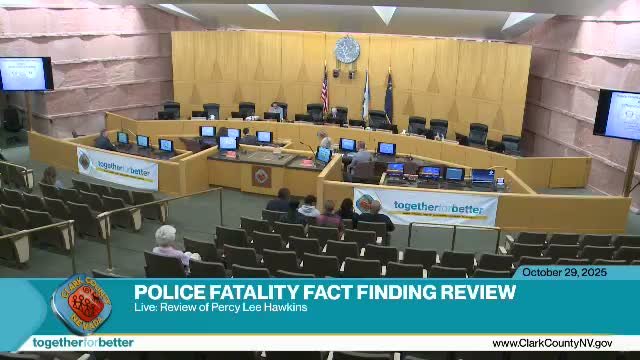
William Janssen, the presiding officer for Clark County’s public fact‑finding review, opened the hearing by saying the Clark County District Attorney’s Office had made a preliminary determination that no criminal prosecution of the officers involved in the Oct. 4, 2024, death of Percy Hawkins was appropriate.
William Janssen, the presiding officer for Clark County’s public fact‑finding review, opened the hearing by saying the Clark County District Attorney’s Office had made a preliminary determination that no criminal prosecution of the officers involved in the Oct. 4, 2024, death of Percy Hawkins was appropriate.
The review, required by Clark County ordinance 2.12 after a DA non‑prosecution determination, was a fact‑finding presentation by the Las Vegas Metropolitan Police Department’s Force Investigation Team (FIT). Chief deputy district attorney Parker Brooks called Detective Andrew Ovens, a FIT investigator, who summarized investigative findings, body‑worn camera footage and crime‑scene photographs.
Detective Ovens said officers Trenzel Allen and Anthony Salinas responded to a disturbance at a casino parking lot near Tropicana and Coval Lane. Ovens identified Officer Allen as hired in November 2021 and Officer Salinas in February 2022. He said Officer Allen fired six rounds from a Glock 19 and Officer Salinas fired 12 rounds from a 9mm Smith & Wesson during the encounter.
Henderson resident Percy Lee Hawkins, 37, was identified as the decedent. Ovens said the Clark County coroner’s office, through Dr. Schaller, conducted an autopsy on Oct. 5, 2024, listing the cause of death as "multiple gunshot wounds" and the manner of death as "homicide." He also reported positive toxicology results for amphetamine, methamphetamine and THC.
Ovens walked the panel through a timeline assembled from CAD records and body‑worn camera timestamps: a reporting call at about 09:58, officers’ arrival at approximately 10:22:45, a radio report of shots fired at about 10:23, medical requested at 10:24 and emergency medical personnel arriving around 10:28. The decedent was transported to University Medical Center and pronounced deceased at 10:44.
Video and stills shown in the review included interior casino footage and body‑worn camera excerpts. Ovens recounted that casino staff described Hawkins as agitated, at one point saying he was God, and that he had a chain wrapped around a hand in a manner casino staff compared to brass knuckles. FIT reported recovering a kitchen knife with an approximately 2.75‑inch blade and a metal chain consistent with improvised knuckles.
Describing audio captured on video, Ovens said Hawkins responded to an officer’s command to drop the knife by saying, in the investigator’s words, "I ain't dropping ****," and approached officers. Ovens said Officer Salinas fell during the encounter and that Salinas’ body camera experienced audio distortion after the fall because of a camera loop/malfunction. Ovens also described drone and street‑view photos that marked the location of the patrol vehicles and where evidence and the decedent were found.
Monique McNeil, the ombudsman appointed to represent the public and the Hawkins family, pressed FIT on training, de‑escalation, alternative tactics and the dispatch information officers received before arrival. McNeil highlighted that the 911 caller, a casino employee, told dispatch that the man was "freaking out," claimed to be God, and had a chain wrapped around his hand; Ovens agreed that such information, if relayed, would affect an officer’s on‑scene plan but said officers do not always receive complete information from dispatch.
McNeil and others questioned the timing between arrival, the officer command and the first shots. Ovens provided recorded timestamps and said Officer Allen discharged his handgun at 10:23:02 after arriving at roughly 10:22:45; participants discussed elapsed time estimates ranging from a few seconds to about 17 seconds depending on which reference was used. Ovens emphasized the encounter unfolded quickly and that FIT’s role is to report facts and evidence to the DA, not to render legal judgments about justification.
The family asked whether officers had been disciplined; Ovens said he was not privy to administrative‑internal affairs outcomes because FIT conducts the criminal‑fact investigation and administrative matters are separate.
Brooks and McNeil also questioned whether less‑lethal options such as OC spray, tasers or shields could have been used. Ovens acknowledged those tools exist and that officers are trained in a continuum of force, but he said those options may not be available or effective depending on time, distance and perceived threat; he added that tasers and some low‑lethality munitions are kept in patrol vehicles, not necessarily on an officer’s person.
Throughout the review witnesses and counsel raised concerns about the number of rounds fired, whether officers reassessed after each shot, and the potential for civilian exposure — Ovens confirmed witnesses reported bullet impacts to nearby building surfaces and that bystanders, including an Uber driver and a construction worker, were present.
The presiding officer closed the review after family questions were exhausted and noted that the investigative reports provided to the DA are public records and that the video of the proceeding is available on the Clark County website. The DA’s preliminary decision not to prosecute remains the DA’s legal determination; the public review presented evidence and family concerns but did not result in a formal legal finding at the hearing.
What happens next: FIT’s criminal investigation and any administrative investigations are separate processes. Ovens said FIT’s report was provided to the DA; whether administrative discipline or further review will follow was characterized as "not specified" in the hearing record.