Get Full Government Meeting Transcripts, Videos, & Alerts Forever!
Get email alerts on the Investigative Procedure topic
No spam. Unsubscribe anytime.
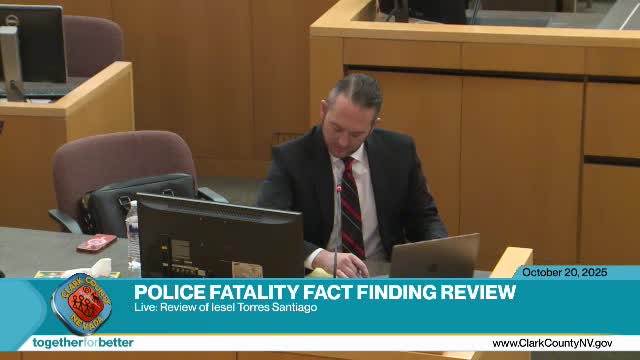
Panel questions walk‑throughs, union counsel presence and evidence access in Torres Santiago review
Summary
During the Clark County public review, the FIT described voluntary walk‑throughs conducted with Las Vegas Police Protective Association counsel present, officers' access to body‑worn camera footage before walk‑throughs, and confirmed the driver of the stolen vehicle requested counsel and that questioning stopped.
A central line of questioning during the Clark County fact‑finding review into the death of E.S.L. Torres Santiago focused on investigative procedure: how FIT conducts walk‑throughs, the presence of union counsel, the timing of interviews, and access to evidence by involved officers.
Ombudsman Michael Troiani and panel members asked Detective Gilberto Valenzuela how walk‑throughs and voluntary statements are handled. Valenzuela said walk‑throughs are voluntary, commonly conducted within six to 72 hours after an incident, and often occur with Las Vegas Police Protective Association (LVPPA) counsel or representatives present to lead or advise the officer through factual confirmations. He explained that the union attorney typically asks the subject officer yes/no questions during the walk‑through and officers can refuse to give formal FIT statements; in this case both subject officers completed walk‑throughs but declined to give formal FIT interviews.
Panelists probed whether officers could review body‑worn camera (BWC) footage or other surveillance before walk‑throughs; Valenzuela said officers were allowed to review available footage and, in this incident, officers reviewed their BWC before the walk‑throughs. Valenzuela said other ancillary footage is available for officers to view but the involved officers in this case limited themselves to their body‑worn camera.
Troiani and others also asked about representation for the arrested driver (initials A.L.). Valenzuela confirmed the driver requested an attorney immediately after arrest, and FIT ceased questioning at that point; the driver was later booked on charges related to paraphernalia and possession of the stolen vehicle.
Panel members asked whether particular investigatory questions were not pursued during walk‑throughs because union counsel led the session. Valenzuela acknowledged that certain lines of questioning, such as about the precise displacement of the firearm after shooting, were not asked by the officers counsel and therefore not addressed during the walk‑through, but that FIT investigators documented scene photos and took notes at the autopsy to capture such details.
The hearing record shows the ordinance that authorizes the public review does not provide subpoena power; the ombudsman and presiding officer may ask questions but cannot compel testimony or additional witnesses beyond those the DAs office elects to present. The panel closed by reiterating that FIT materials provided to the ombudsman and presiding officer are public records and a recorded video of the proceeding is available on the county website.