Get Full Government Meeting Transcripts, Videos, & Alerts Forever!
Get email alerts on the Fuel Indexing topic
No spam. Unsubscribe anytime.
Unions and residents urge Clark County to keep fuel-indexed revenue as commissioners hear public support
Summary
Labor unions, construction and trades representatives, and residents urged the commission to maintain fuel-indexed revenue for road maintenance and jobs; speakers argued indexing avoids cuts to roadwork and preserves employment. The board set related ordinance work to address state-level changes (AB 530).
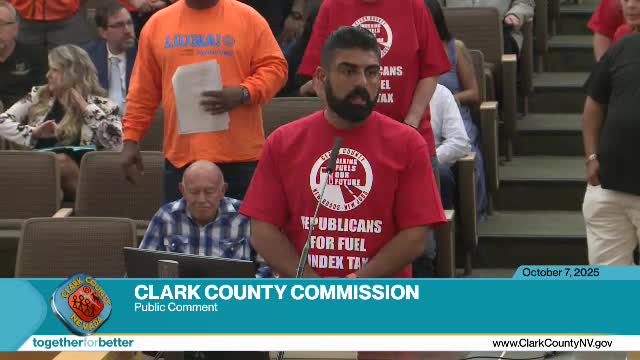
Dozens of union members, tradespeople and residents urged Clark County commissioners Oct. 7 to support fuel-indexing measures that preserve steady revenue for road maintenance and local construction jobs.
Speakers from Laborers Local 872, IBEW, Teamsters, and other trade groups described fuel-indexed revenue as a dependable funding source for road work and safe streets. "The fuel revenue index isn't just about gas, it's about keeping Southern Nevada moving," said Jesus Loya, business manager for the Roofers and Waterproofers. Several speakers tied the index directly to jobs: construction craft laborers representing thousands of families said the indexing helped sustain employment and training programs.
Other public commenters, including Republican and nonunion residents, said indexed revenue prevents shortfalls in essential maintenance and reduces long-term taxpayer costs caused by deferred repair. One commenter framed it as "a couple extra cents at the pumps versus raising taxes," reflecting a common local position favoring user-fee approaches.
Separately, the commission introduced an ordinance to amend Title 4 of the Clark County Code to oppose limits on additional vehicle and fuel taxes as authorized by Assembly Bill 530; the board set that item for public hearing on Nov. 18, 2025.
No final local tax action was taken Oct. 7; the meeting served principally as a public forum for labor and residents to press the county to retain or support fuel-indexed mechanisms and to set a public hearing on the ordinance that would frame county policy in response to state changes.