Planning commission denies BridgeSource plan amendments for Moapa cement plant after widespread community opposition
Loading...
Summary
The commission voted to deny two plan amendments that would have redesignated roughly 384 acres in Moapa Valley to industrial employment and to alter the transportation map; commissioners cited unresolved environmental, cultural and community concerns and asked that NEPA and additional studies continue before further approvals.
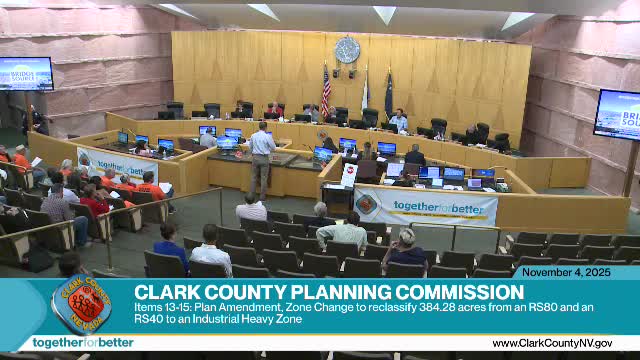
The Clark County Planning Commission on Nov. 4 voted to deny two plan amendments tied to BridgeSource’s proposal for a cement plant and adjacent limestone quarry in Moapa Valley, citing broad community opposition and outstanding environmental and procedural questions. Because the land‑use amendments were denied, the companion zone change to Industrial Heavy was rendered moot.
BridgeSource representative Merrill Squire described the project as a response to chronic shortages of cement and said the company’s analysis estimates the operation could generate significant local tax revenue and hundreds of jobs. Squire told commissioners the proposal would require federal NEPA review for the quarry, air permitting through Clark County Division of Air Quality, and other permitting; he also said cultural surveys had been performed and that some tribes participated in those surveys. On economic impact, Squire cited an independent review: “we would generate something on the order of $10,000,000 per year for the first 10 years of operation in tax revenue.”
But dozens of residents, tribal leaders and environmental groups pressed the commission to deny the plan amendments. Public commenters cited the project’s proximity to homes and elementary schools, concerns about air quality and dust from blasting and rock crushing, impacts to the Muddy River (a tributary contributing to Lake Mead), the presence of endangered species (including the Moapa dace and Virgin River chub), historic and tribal cultural resources, FEMA flood‑zone exposure and insufficient local consultation. Ivan Reel, tribal chairman of the Moapa Paiute Nation, said the tribe had not been adequately consulted and asked that the commission oppose rezoning until tribal and environmental reviews were complete.
Commissioners asked technical questions about NEPA timing (applicant said the pre‑NEPA review is near completion and an EIS could take up to 12 months once initiated), mitigation for flood risk (applicant said the plant footprint would be raised on fill and stormwater measures developed), the 400‑foot preheater tower and long‑term visibility, and the scope of a proposed 2,200‑acre quarry. Several commissioners said they were inclined to delay action until environmental studies and the RISE/regional infrastructure analyses were complete, and expressed concern that approving land‑use amendments now would lock heavy‑industrial zoning in place even if later federal permits were not granted.
Commissioner Stone made a motion to deny PA2570040 (item 13); that motion carried. He then moved to deny the transportation map amendments (PA2570041, item 14); that motion also carried. Because the proposed master plan amendments failed, staff said the zone change item (15) was rendered moot and not acted upon. The items will be forwarded to the Board of County Commissioners for final action as recorded, with staff noting the BOCC hearing on Dec. 3, 2025.
The commission’s action preserves the current agricultural/open‑land and residential designations on the parcels while the public process continues. BridgeSource and opponents were encouraged by commissioners to continue technical outreach, participate in NEPA and permitting processes, and to negotiate community measures such as workforce commitments and tribal consultation ahead of any future zoning proposals.