Get Full Government Meeting Transcripts, Videos, & Alerts Forever!
Get email alerts on the Mosquito Abatement topic
No spam. Unsubscribe anytime.
Clark County explores mosquito abatement district as residents and experts warn of mosquito-borne risks
Summary
After public health testimony and multiple public comments, the commission directed staff to explore creating a mosquito abatement district under state law, consult the health district and UNLV, and return with financing and boundary options.
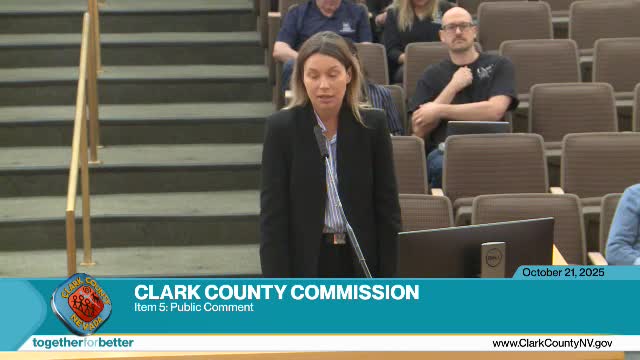
Chairman Seicherblum introduced an item Oct. 21 asking staff to explore establishing a mosquito abatement district pursuant to state law. The discussion followed public comments urging county action and a public-health briefing that described recent trends in mosquito species and disease risk.
Dr. Louisa Messenger, assistant professor in the UNLV School of Public Health, told the commission there are two separate mosquito problems locally: ongoing West Nile virus transmission (documented in Clark County since 2004) and the 2017 invasion and fast spread of a second species now present in 82 zip codes. "This is an entirely preventable disease if we were to do vector control," she said, warning the new species can transmit dengue, chikungunya and other viruses if introduced.
Multiple public commenters supported forming a district. David Brown said a special district under NRS 308 "is the right way to go" to create a comprehensive, proactive mosquito-control authority; Al Rojas and others described personal nuisance and health concerns.
Chairman Seicherblum summarized legal authority and financing options and noted the county could propose a property tax or place a measure on the ballot. "We're actually allowed to even enact a tax, a property tax...without any authority from this from the legislature," he said during the discussion. Commissioners asked staff to coordinate with regional partners (the Southern Nevada Health District, UNLV and municipalities) and return with a holistic plan and potential funding scenarios rather than an ad hoc program.
Outcome: The commission gave direction to staff to develop a proposal and stakeholder outreach plan; no ordinance or tax was adopted at the meeting.
Why it matters: Commissioners, public health experts and residents emphasized both nuisance impacts and public-health risk posed by expanding mosquito populations. The directive begins a formal county-level planning process for abatement, funding and interagency coordination.
What’s next: Staff will consult the health district, UNLV and other jurisdictions, then return with options on program scope, legal authority, property-tax or ballot mechanisms and geographic boundaries.