Get Full Government Meeting Transcripts, Videos, & Alerts Forever!
Get email alerts on the Land Availability topic
No spam. Unsubscribe anytime.
UNLV economist: federal ownership, developability filters limit Clark County’s vacant land supply
Summary
Dr. Sean McCoy told the Clark County Commission that although much parcel acreage appears vacant, ownership and physical constraints greatly limit developable land; he cited data showing high shares of federal control and urged parcel-level analysis before policy changes.
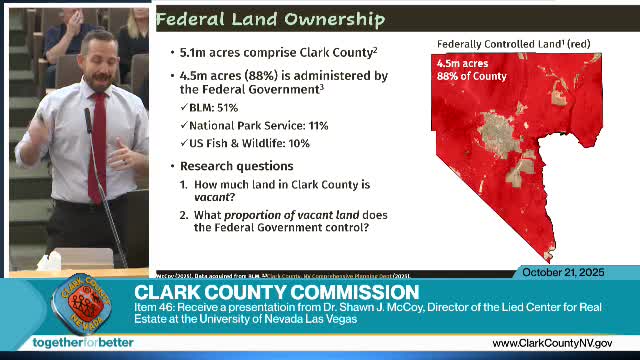
Dr. Sean McCoy, director of the LEED/Lehi Center for Real Estate at the University of Nevada, Las Vegas, told the Clark County Commission on Oct. 21 that headline counts of “vacant” land overstate what is practically available for development.
McCoy, an economist who said his presentation was a data talk rather than a policy prescription, said “88% of Clark County’s land mass is federally controlled,” and that when county parcel data are layered with federal boundaries the result is that “94% of all vacant parcels are currently federally controlled.” He added that only 6.3% of the county’s land mass lies within the federal disposal boundary commonly considered for transfer or sale.
His presentation distinguished vacancy from developability. McCoy walked commissioners through parcel-level filters — slope, zoning, ownership and parcel size — showing how steep slopes and narrow ownership categories reduce the acreage that could support housing or employment centers. He said just under 10% of buildings in the county are 50 years old now, but that share will more than double in 13 years, which could create adaptive-reuse opportunities in the future.
McCoy flagged a potential mismatch between job growth and available employment parcels: relying on prior inventories and his own analyses, he said one study estimates a roughly 470-acre employment-land shortage by 2030 under mid-range job scenarios. He also showed that most recent development acres have been single-family: roughly 91% of land acreage developed for housing in recent years has been for single-family homes and single-family development has outpaced multifamily in unit absorption by a large margin.
Commissioners and the public asked for local specificity. Commissioner Kirkpatrick pressed McCoy for county-specific regulatory clarifications following the county’s recent Title 30 rewrite; McCoy said the presentation was intended to establish a research agenda that could inform public hearings with written analyses of regulatory choices. Public commenters had urged the presentation consider water and transit limits; Mingjay Yan said, “I’m very concerned about water — the presentation doesn’t mention water,” and urged zoning and transit planning be considered alongside land policy.
Why it matters: McCoy’s data show that simple acreage totals can mislead policy debates about land transfer and infill; the distinctions between vacancy, ownership and developability will shape how the county and regional partners consider zoning reform, infrastructure costs and economic development objectives.
What’s next: McCoy recommended more targeted parcel-level research, benchmarking against peer cities, and coordinated work on regulatory and financing constraints before adopting major land-transfer policies. The commission asked staff to keep the analyst informed and indicated interest in additional, localized analyses.