
Clearwater vulnerability assessment flags rising flood and heat risks; study prioritizes trees, acquisitions and targeted infrastructure
Get AI-powered insights, summaries, and transcripts
Sign Up Free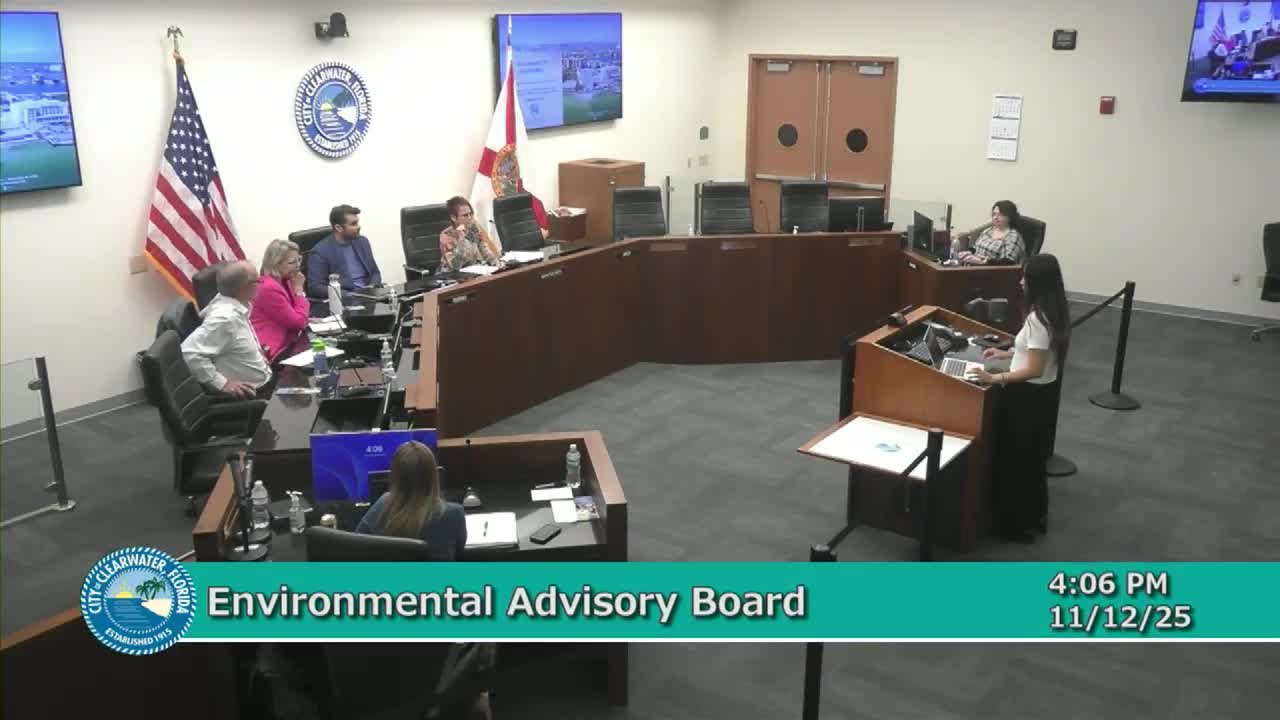
Summary
Clearwater officials on Nov. 12 presented a vulnerability assessment that projects substantially higher flood depths and far more high-heat days through 2100, and outlined a set of high-return adaptation scenarios for the city to consider.
Clearwater officials on Nov. 12 presented a vulnerability assessment that projects substantially higher flood depths and far more high-heat days through 2100, and outlined a set of high-return adaptation scenarios for the city to consider.
The study, prepared with a consultant and funded through the Florida Department of Environmental Protection’s Resilient Florida program, created a GIS-based "digital twin" of city parcels, buildings and infrastructure and modeled tidal, riverine and heavy-rain flooding as well as heat exposure across planning horizons 2040, 2070 and 2100. "By completing this assessment, the city also becomes eligible for future adaptation and resilience funding opportunities," Melody Yin, sustainability specialist in Public Works, told the Environmental Advisory Board.
Why it matters: staff said the assessment gives Clearwater a data-driven way to prioritize investments that avoid future damage — particularly in coastal and low-lying neighborhoods — and to pursue grants that can offset local costs. The report applied a cost–benefit framework (losses avoided divided by cost) to evaluate ten adaptation scenarios, then selected five for more detailed analysis.
Key findings and modeled options included: - Flooding and storms: Using NOAA-based sea-level projections, the team modeled increases in flood depth for 100- and 500-year rainfall events and projected more intense storms by 2100. The presentation cited a modeled ~24% increase in 100-year, 24-hour rainfall intensity by 2100 and higher maximum flood depths in later planning horizons. - Heat exposure: The study flagged a substantial rise in days above 90°F in many locations by 2100; presenters said the number of very hot days could reach into the hundreds annually in some modeled areas and stressed the importance of clarifying baseline measurement methods in follow-up materials. - High-ROI interventions: Scenarios that showed strong benefit-per-dollar included targeted acquisitions and road/bridge elevations in the Stephenson Creek watershed, tree-planting focused on tree deserts and vulnerable neighborhoods, seawall maintenance/repair for city-owned walls, and selective structure elevations on barrier islands.
The presentation quantified several scenario results that will inform future planning. For example, staff described an ROI-maximizing Stephenson Creek package at about $200 million across 79 projects (including eight road elevations and 71 acquisitions) estimated to avoid roughly $297 million in damages, and a tree-planting scenario with a modeled investment near $3.62 million identifying about 7,200 priority planting locations. A citywide acquisition scenario was shown as effective on paper but costly and politically sensitive: the study modeled roughly $1.5 billion spread over hundreds of buyout projects with a sizable avoided-damage estimate.
Implementation caveats: staff repeatedly cautioned the scenarios are planning-level and do not commit the city to action. "These scenarios are in support of high-level planning — they are not meant to imply that the city is going to perform these actions," Melody Yin said. The team also noted technical limits in the simulator (for example, some scenarios could not fully evaluate mixes of soft and hard mitigation) and that many seawalls are privately owned, which constrains city-led seawall elevation strategies.
Public questions and concerns: Residents and board members pressed for detail on baseline data, how ROI and avoided-damage estimates are calculated, and whether taxpayers would be expected to pay to elevate private homes. Resident William Johnson asked directly whether the city would fund elevation of private North Beach homes or instead use acquisitions; staff replied acquisition is one modeled option and committed to clarify near-term priority actions in follow-up materials for council and future meetings.
Next steps: staff said the city will publish a readable summary and the full report at myclearwater.com/va, pursue implementation grants (including Resilient Florida implementation funding), expand tree-canopy analysis through a proposed urban forestry plan, improve data collection for future modeling, and engage residents — especially in vulnerable neighborhoods — as it refines priorities. For questions, staff provided sustainability@myclearwater.com.
The board discussed outreach and education and asked staff to return with clearer baseline definitions and more details on near-term actions and funding options.