Get Full Government Meeting Transcripts, Videos, & Alerts Forever!
Get email alerts on the School Facilities topic
No spam. Unsubscribe anytime.
Vigo County commissioners ask council for $100,000 to form oversight board to vet school facilities plan
Summary
County commissioners asked the Vigo County Council to appropriate $100,000 to establish an oversight board under House Bill 1515 to study and recommend funding options for school facility improvements; council members pressed legal and liability questions and dozens of residents — including students and teachers — urged approval.
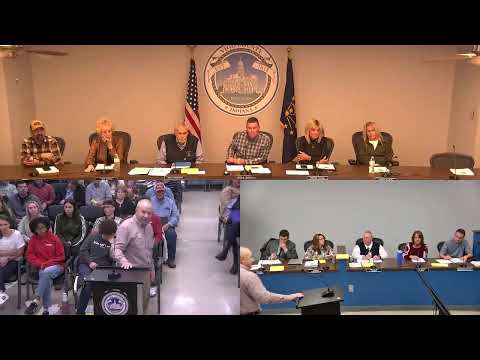
Mark Clinkenbeard, president of the Vigo County Commissioners, asked the County Council to approve a $100,000 appropriation to create an oversight board under House Bill 1515 that would evaluate funding and delivery options for school facility improvements. The commissioners described the board as advisory and focused on fact-finding rather than direct spending decisions.
Why it matters: Commissioners and business leaders argued the county faces population and economic losses tied to deteriorating school facilities and said an independent, publicly visible process could identify funding mixes that reduce reliance on property taxes. Opponents on the council warned the statutory language may expose the county to legal risk if the board’s expenses or actions are interpreted broadly.
Clinkenbeard said the oversight board would be a ‘‘fact finding and recommendation tool to guide future decisions’’ and that the $100,000 would fund professional analysis rather than an open-ended commitment. Kristen Craig, president and CEO of the Terre Haute Chamber of Commerce, told the council the Chamber supports the board and presented slide-based estimates showing families leaving Vigo County because of school conditions, a loss she described in dollar terms and long-term jobs and revenue implications.
Jewel Lee, a municipal attorney from Taft Law retained to advise the commissioners, provided a detailed reading of House Bill 1515 and told the council the statute limits the committee’s powers to oversight and management of funds the county transfers or gifts to a school corporation. "They cannot appropriate dollars for the county. They cannot enter into contracts on behalf of the county," Lee said, describing the commission’s role as constrained by statute. Lee also answered questions about the statute’s subsection that says the county "shall pay" certain expenses, saying that, read in context, the obligation applies only to expenses tied directly to oversight and management of funds the council transfers.
Council members repeatedly pressed Lee and the commissioners on potential liability. Councilman Steve Ellis said he was concerned that a committee with unclear contracting authority could leave the county defending lawsuits or paying unexpected bills. "Why would we put ourselves in a compromising position when the same work can be done without putting ourselves in a compromising position?" Ellis asked, urging consideration of alternatives such as a privately funded study or having the commissioners contract directly for a municipal advisory (MA) study.
Representatives of the casino foundation clarified that the foundation has not yet committed a specific $100,000 gift and that any donation would require foundation board approval. Commissioners said the foundation had signaled willingness to consider contributing and that public-private partnerships could be part of a capital stack to reduce tax impact.
Public comment was lengthy and emphatic. More than a dozen speakers — including teachers, parents and students — described failing facilities and personal experiences, from repeated bathroom closures and broken plumbing to classrooms with poor heating and air conditioning. Student leaders urged the council to act for the community’s future; a special education teacher said her son’s needs made the matter personal. "It is never a bad idea if we are going to be taxed anyway... I want to see it benefit my children, not 50 years from now," said Summer Liggett, chief probation officer presenting earlier in the meeting and a public commenter on school conditions as a teacher.
What’s next: The commissioners asked the council to vote on the appropriation; the meeting record shows extended discussion but no completed vote on the $100,000 appropriation in this session. Council members may schedule the appropriation for a future vote or adopt alternative approaches such as contracting directly for consulting services that would be held by the commissioners. The oversight-board proposal and public debate are likely to return to the council for a motion and formal vote.
Provenance: Discussion of the commissioners' request and legal briefing begins with Mark Clinkenbeard introducing the request (transcript start) and continues through Jewel Lee’s statutory analysis and the public comment period. The main discussion appears in transcript segments beginning at SEG 711 and continuing through the public comment that ends near SEG 3400.
Speakers quoted or referenced: Mark Clinkenbeard, President of the Vigo County Commissioners; Kristen Craig, President and CEO, Terre Haute Chamber of Commerce; Jewel Lee, partner, Taft Law (municipal group); Dr. Hemsel, superintendent (Vigo County School Corporation); Councilman Steve Ellis; representatives of the Casino Foundation; multiple public commenters including teachers and students.
Clarifying details: The request specifically cited House Bill 1515 as the enabling statute for an oversight board; counsel and the legal adviser repeatedly said the board’s authority is tied to funds the county transfers or gifts to the school corporation. The commissioners requested $100,000 as an initial appropriation to pay for studies and expertise; casino foundation involvement was described as "potential" and not yet a committed gift.
Topics: school facilities; House Bill 1515; public-private funding; community engagement.