Get Full Government Meeting Transcripts, Videos, & Alerts Forever!
Get email alerts on the Continuous Improvement topic
No spam. Unsubscribe anytime.
Rescue Union superintendent outlines continuous-improvement push after employee surveys show mixed results
Summary
Superintendent Jim presented three years of continuous-improvement work, described two employee surveys (56% participation, 265 of 441 respondents), noted district scores slipped from 4.04 to 3.94, and set team-level action plans with an Oct. 13 professional development day and an Oct. 15 team-rollout deadline.
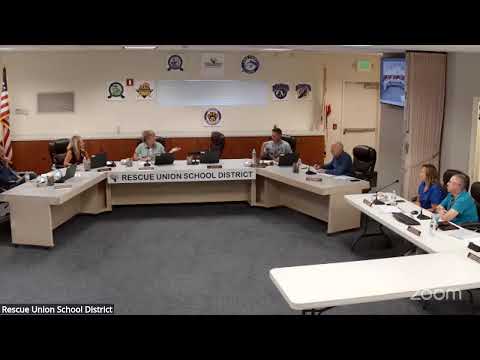
Superintendent Jim opened the board study session by saying the district's priority is building a culture of excellence through continuous improvement and that the presentation would focus on practical tools and data from the last three years. "Our goal really tonight is to look at our continuous improvement," he told trustees.
The board heard a short video framing the strategy as the "aggregation of marginal gains," the idea that many small system changes can compound into large performance improvements. Jim said the district has applied that idea through leader coaching and four regular surveys: student surveys provided by staff, the LCAP parent survey, the District Services Survey (November-December), and the Employee Experience Survey (spring).
Jim walked trustees through how the district uses the two employee-focused tools. The District Services Survey asks users to rate departments on five items (accessibility, accuracy of information, attitude, timeliness and efficiency), with a district target of 4.0 or better on each item. The Employee Experience Survey asks 20 questions about team and organizational experience; the district's goal is that 75% of those 20 items score 4.0 or higher.
On participation and headline results, Jim said 56% of employees took the survey (265 of 441), and the district's overall employee score decreased from 4.04 in 2023 to 3.94 in the most recent administration, a 2.5% reduction he described as near the cusp of statistical significance. "We did go down," Jim said, adding that leaders need to probe causes before changing survey timing or instruments.
District office results showed modest gains in some areas: the district office increased the number of questions that exceeded the 4.0 goal from seven to 10. Jim identified recurring lower-scoring items (questions 11 and 6) tied to perceptions that organizational resources and communication across departments are not consistently allocated or timely. He said the district is following up by asking leaders to meet with staff and identify what "resources" means in each context'time, money, technology, or basic supplies.
Trustees and staff discussed concrete, low-cost fixes Jim described as examples of systems thinking: moving from generic to "intentional" thank-you cards, structuring 1:1 meetings with focused questions ("Where are you crushing it? What's keeping you awake?"), and establishing a centralized Google "one-stop" doc to reduce time spent locating agendas and documents. Jim said those small changes are meant to be sustainable and not add to employees'workloads.
Studer, the external coach and vendor the district used, provides back-end survey administration and benchmarking; Jim said the district has a three-year contract and is exploring a gradual release of services while retaining the back-end survey processing if affordable. "They give us the score and the comparison from last year," Jim said, and Christina led local theming of comments this year so leaders receive digestible themes rather than overwhelming raw text.
Board members pressed on rollout and buy-in. Jim and other leaders said the work began slowly to build trust and emphasize that surveys and coaching would be used to support leaders, not to punish them. Amy Fowler, described by staff as the coach who worked directly with leaders, and monthly leadership retreats were credited with helping introduce protocols (for example, a stoplight protocol for crisis response) and building relationships.
The district also discussed differences between site-based teams and central departments: site leaders typically have weekly meeting structures that make continuous-improvement work easier to embed, while departments such as food services must find other ways to convene staff who work different shifts. Staff said food services used Studer'provided templates and coaching to improve practices such as how students are received in the lunch line.
For next steps, Jim said each principal and department leader must review themes with teams and develop action plans before Oct. 15; the district plans a professional-development day on Oct. 13 centered on MTSS and classroom-level supports. He emphasized leaders should pick one focused improvement goal for the year and keep it top of mind.
Trustees praised the transparency and the district's positive culture. A motion to adjourn was moved by Trustee (speaker 5) and seconded by Trustee (speaker 8); the transcript records the motion and second but does not record a formal vote.
The transcript does not provide full last names for several staff speakers. Where the record lists a first name only, the article identifies the speaker by the given name and role as stated in the meeting (for example, "Superintendent Jim").