Get Full Government Meeting Transcripts, Videos, & Alerts Forever!
Get email alerts on the Homelessness topic
No spam. Unsubscribe anytime.
Washington County liaison urges Tualatin to consider safe‑parking as bridge to housing
Summary
Megan Cohen, the county‑city homelessness liaison for Tigard, Tualatin and Sherwood, briefed the council on safe‑parking models used nearby and said the program provides a bridge to housing while eviction‑prevention funding and shelter capacity have declined.
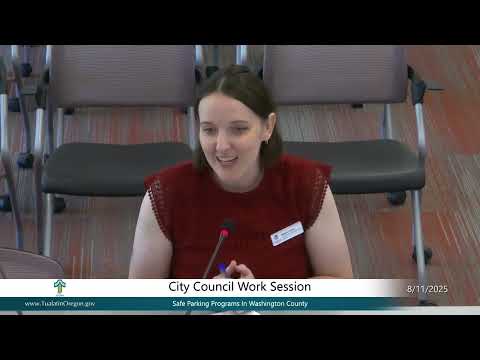
Megan Cohen, the city‑county homelessness liaison for Tigard, Tualatin and Sherwood, told the Tualatin City Council on Aug. 11 that Washington County safe‑parking programs offer a low‑cost, case‑managed bridge to permanent housing at a time when eviction‑prevention dollars and shelter capacity are strained.
Cohen said funding reductions at state and federal levels have reduced eviction prevention support and that some rapid‑rehousing and domestic‑violence program dollars have expired. “We are seeing a lot of families facing rent increases and eviction without resources,” she said, and noted that family and adult shelters are at 100% capacity with month‑long waiting lists.
Safe parking, Cohen explained, is intended as a transitional program that requires participants to accept case management, background checks and a site code of conduct. “Safe Parking is … three dedicated parking spaces for households living at a designated site,” she said, adding that a typical site also includes a restroom/handwashing station and a storage pod. Cohen gave rough costs: about $100,000 for five sites (roughly $50,000–$60,000 for case management covering 15–20 households and about $10,000 per site for on‑site infrastructure).
She described the operator model used in nearby cities: jurisdictions fund the program and contract with a service provider to run intake, background checks, wait lists and case management. Just Compassion currently operates Beaverton and Tigard sites; Cohen said Beaverton served about 65 individuals last year with roughly an 85% transition rate to housing, and Tigard has served a smaller cohort (12 households with four transitions so far), noting that turnover is slow and families typically take months to move into permanent housing.
Councilors asked for cost comparisons with eviction prevention. Cohen cited Family Promise of Tualatin Valley’s figure that eviction prevention assistance averages about $4,000 per family to cover back rent and keep families housed. Cohen said safe parking’s goal is to connect people with services and provide a stable location for outreach while they await shelter or housing placement.
On operations and enforcement, Cohen said operators (in her examples, Just Compassion) manage day‑to‑day enforcement, coordinate with police for safety or tow actions, and run community outreach including good‑neighbor agreements. She told councilors that the program can be structured to prioritize local residents and that host sites (churches or municipal lots) typically do not bear direct costs beyond providing parking spaces.
The council did not vote on creating a program but sought additional details about shared‑cost models, potential host sites and how safe‑parking would coordinate with local services.