Get Full Government Meeting Transcripts, Videos, & Alerts Forever!
Get email alerts on the Redistricting topic
No spam. Unsubscribe anytime.
Cheshire School District narrows elementary redistricting to two scenarios as transportation review continues
Summary
Consultant-tested options A–E; the district and MP Planning identified scenarios B and E as best balancing capacity and bus routing. Both avoid exceeding the district's 100% planning target across a 10-year horizon; staff expect a transportation analysis in weeks with a preferred plan for the board in December.
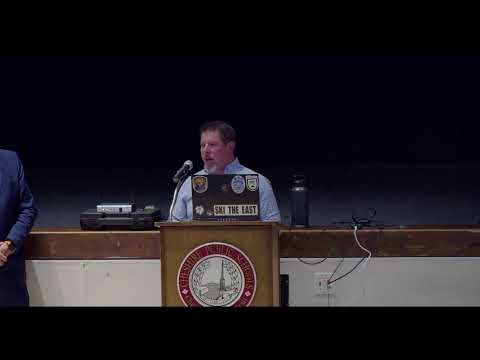
A consultant for the Cheshire School District presented five elementary redistricting maps Wednesday and said two options—labeled B and E—best balance building capacity and transportation efficiency, pending a detailed transportation review.
Mike Zuba of MP Planning told families and board members the district's medium enrollment projection shows about a 13% increase across preK–12 in the 10-year window, reaching roughly 4,800–4,900 students, and an approximate K–6 rise of 160 students in the first five years. "We're projecting about a 13% increase overall, reaching about 4,800 students in the first five years," Zuba said during his presentation.
Why it matters: two new elementary schools are opening next year and attendance zones must be set. The district said it uses a planning loading of 20 students per classroom with 10% headroom (yield ≈18 students) to set operational capacity so schools retain flexibility for growth and program needs.
What the scenarios do: Scenario B reassigns neighborhoods to even out enrollment across Barnum, Norton, Highland and Doolittle. Zuba said Scenario B produces five-year averages of about 610 students at Barnum, 600 at Norton, roughly 740 at Highland and just under 500 at Doolittle, with no facility exceeding the district's 100% planning target. Scenario E is transportation-driven, using Route 10 as a primary dividing line to reduce bus travel and routing complexity; under E, Barnum's five-year average was about 590–625, Norton's peak about 600, Doolittle about 520 and Highland about 740, also below the 100% planning threshold.
What was rejected: Zuba said Scenario A, an older map that accompanied the district's school construction grant, would have pushed Barnum toward roughly 720 students and more than 110% utilization at the projection midpoint, so it was not pursued.
State policy uncertainty: Board member Tim White asked whether pending state housing legislation could alter these plans. Zuba responded that the referenced senate bill (which had been vetoed earlier) is planning-related and would likely have a longer lead time; he said it would not produce immediate changes but acknowledged uncertainty about any future housing mandates that might affect local enrollments.
Next steps: Zuba said transportation staff and the district's vendor will complete a routing analysis in the coming weeks to compare average ride times and the number of buses needed under B and E. Superintendent Jeff Solon and the consulting team aim to present a preferred scenario for adoption at the board's December meeting. The district posted interactive maps and a home-finder tool to let families see where addresses would fall under the two leading scenarios.
The district did not vote on a plan at the public presentation; officials said they will solicit community feedback before the board acts.