Get Full Government Meeting Transcripts, Videos, & Alerts Forever!
Get email alerts on the Health Education Standards topic
No spam. Unsubscribe anytime.
Parents flood State Board with public comment opposing draft Michigan health education standards
Summary
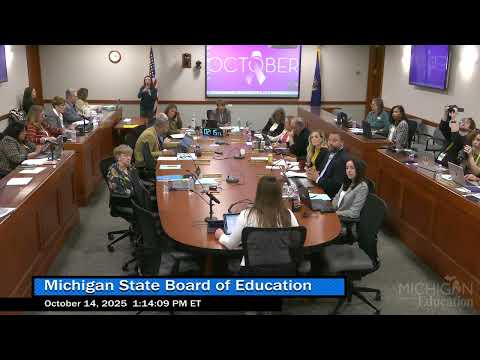
LANSING — Dozens of parents and community members spent much of Tuesday afternoon telling the Michigan State Board of Education they oppose the department’s draft 2025 Health Education Standards, arguing the document moves sexual-education content into required health classes and undermines parents’ ability to opt children out.
LANSING — Dozens of parents and community members spent much of Tuesday afternoon telling the Michigan State Board of Education they oppose the department’s draft 2025 Health Education Standards, arguing the document moves sexual-education content into required health classes and undermines parents’ ability to opt children out.
The meeting opened with staff advising each speaker would have three minutes. John Grusselbacher, a candidate for the state House, told the board the draft “strips parents of the option to opt out, a right guaranteed by Michigan law, MCL 380.1507,” and called large portions of the document “not academic standards” but a “parenting manual.”
Supporters and opponents appeared in the room. Taryn Gao, a parent and former local advisory board member, urged adoption, saying the draft is guidance rather than curriculum and “parents retain the right to opt their child out.” “These are best-practice recommendations,” Gao said, adding that the 2007 standards are outdated. Al Craven, a retired health educator, also urged passage, citing classroom examples of health instruction benefits.
But most in-person commenters urged rejection. Multiple speakers said the draft “weaves” sexual-education topics and language about gender identity into health standards and thus would effectively bypass statutory opt-in protections for sexual education. Kristen Lee of Citizens Defending Freedom cited the U.S. Supreme Court decision Mahmood v. Taylor and Michigan statutory language and said advisory boards would lose meaningful oversight if content is embedded in mandatory health classes.
The board paused public comment after roughly an hour to consider a motion from Board Member Tom McMillan to extend the public-comment period to hear everyone who had registered. That motion failed on a roll-call vote. The board then approved a narrower motion to finish hearing in-person speakers and later resume online commenters.
Board discussion during the meeting reflected the split in public testimony. Several members, including President Doctor Pugh, emphasized the department’s repeated statement that the draft is a framework, not curriculum, and that the standards include parent-review and opt-out safeguards. “Parents should never be left out of the equation,” Pugh said, urging anyone with concerns to read the document’s local-control provisions.
Opponents disagreed on interpretation. Board Member Nikki Snyder and Board Member McMillan said the draft violates both Michigan statutory distinctions between health education and sexual education and the standard the Supreme Court described in Mahmood for when curriculum becomes constitutionally actionable. “These are beliefs and ideology woven into standards,” McMillan said during debate.
Snyder introduced a resolution asking the board to make a formal finding about statutory compliance of specific standards. After extended debate and a procedural call of the question, the resolution failed on a roll-call vote.
What’s next: The Department of Education told the board it will accept public comment through the published public-comment period and then reconvene stakeholders before returning the standards for further board consideration. Board members repeatedly urged parents to engage with the department’s materials and with local school districts, while acknowledging sharp disagreement among citizens about what belongs in K–12 health instruction.
Authorities and sources cited at the meeting included MCL 380.1507 (parental notification and opt-out for sexual education), act 451 of 1976 (references to elective sexual education), and the U.S. Supreme Court opinion Mahmood v. Taylor, which several speakers and board members invoked in arguing whether topics had been “interwoven” into required instruction.
The board did not adopt or reject the standards at Tuesday’s meeting; it handled routine business, heard presentations, and voted on unrelated resolutions before resuming online public comment.