Get Full Government Meeting Transcripts, Videos, & Alerts Forever!
Get email alerts on the Stormwater Drainage topic
No spam. Unsubscribe anytime.
Utilities committee advances Providence Trails drainage plan after easement limits alternatives
Summary
The City of Appleton utilities committee voted 3-0 to advance staff-recommended Alternative 3 — a right-of-way/easement and lot improvements package estimated at $330,000 to the stormwater utility — after staff reported TC Energy will not permit a parallel storm pipe in its easement.
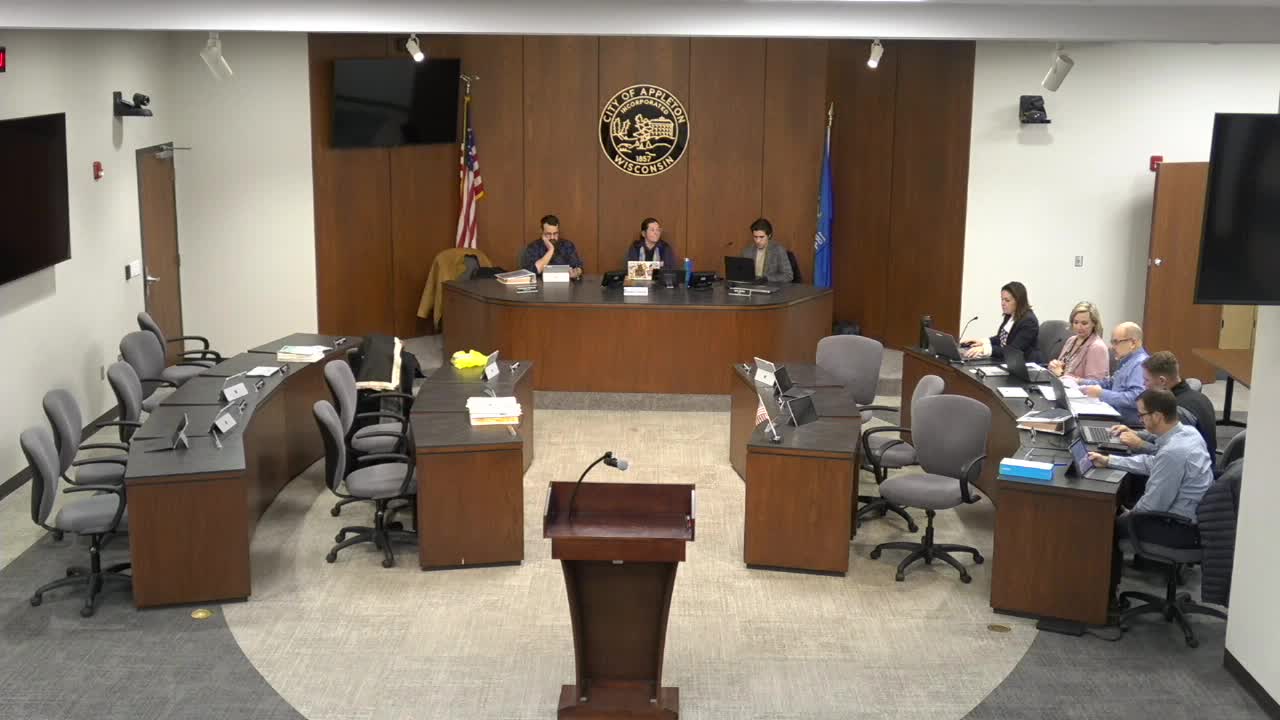
The City of Appleton Utilities Committee voted 3-0 Nov. 11 to recommend a staff-backed drainage approach for the Providence Trails neighborhood after learning the pipeline easement holder would not permit a parallel storm sewer.
Deputy Director Neuberger told the committee staff recommends Alternative 3, which includes right-of-way/easement work and lot improvements: about 164 linear feet of yard drain upsizing, roughly 460 linear feet of new 24-inch storm sewer, construction of a dry pond for flood storage south of Apple Creek Trail, placement of up to 14 yard drain inlet castings and an estimated $330,000 charge to the stormwater utility.
Neuberger said follow-up communications with TC Energy, the easement holder, produced a definitive response that a parallel storm pipe within the pipeline easement would not be permitted; if the city submitted a permit application for such a pipe, TC Energy confirmed it would not approve it. That constraint eliminated a potential fourth alternative that staff had explored.
Resident Tom Raessler urged the committee to consider a perpendicular crossing instead of a parallel pipe, saying technicians told him perpendicular crossings are often approved and that nine properties in the subdivision face flooding risk. Raessler said Alternative 3 would address roughly four of those properties and warned the remaining risk could create city liability.
Neuberger replied that DPW performed a high-level analysis of a perpendicular option and found the receiving storm system on the south side of the trail is not sized to accept additional north-side flow. Upsizing the south-side system would require substantial work; staff estimated a ballpark cost of about $1,600,000, roughly comparable to another larger alternative but serving fewer north-side properties.
Committee members discussed trade-offs, stressing they did not want to solve flooding for some properties while creating problems for others. Chair Sherry said funding constraints prevent a full system overhaul now, but the committee can prioritize projects to seek future funding or pair work with street reconstructions to avoid duplicative pavement costs.
The committee recorded a 3-0 vote to proceed with Alternative 3 and recommended the item for consideration by the Common Council at its next meeting, scheduled for 7:00 p.m. the following week.