
Austin Water commission backs collaboration agreement for ASR testing after heated public concern
Get AI-powered insights, summaries, and transcripts
Subscribe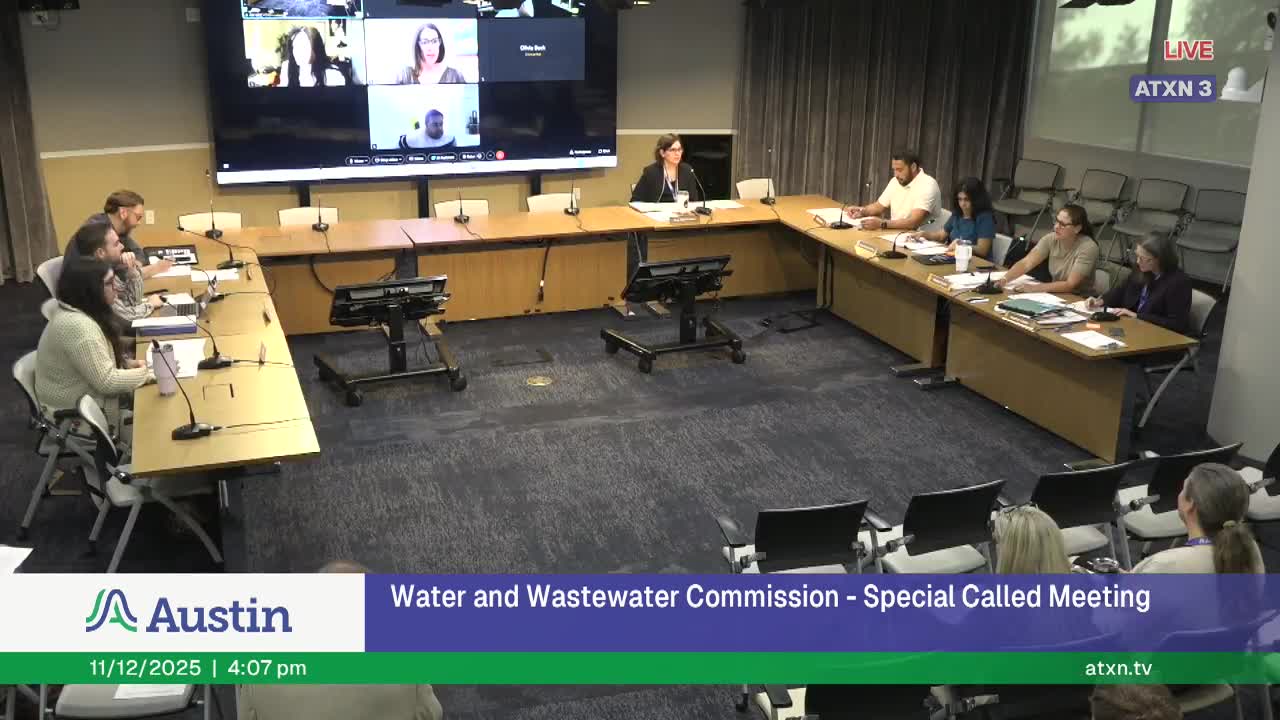
Summary
The Austin Water & Wastewater Commission on Thursday recommended City Council approve a collaboration agreement to govern stakeholder participation during laboratory and field testing for an aquifer storage and recovery (ASR) project that would store treated Austin water in parts of Bastrop and Travis counties.
The Austin Water & Wastewater Commission on Thursday recommended that City Council approve a collaboration agreement that would govern stakeholder participation during laboratory and field testing for the utility's proposed aquifer storage and recovery (ASR) project in Bastrop and Travis counties.
State Representative Stan Gertes, who says he represents Bastrop, Milam, Lee, Burleson and Caldwell counties, urged the commission to pause the project and reject the agreement, saying Bastrop residents and local elected officials overwhelmingly oppose injecting treated water across county lines. "Crossing county lines to inject treated water into an aquifer that serves another community is not responsible planning — it's government overreach," Gertes said during public comment. He added that he has filed legislation and would push every available legislative tool to stop the project.
Austin Water staff, led by Director Shay Raulston, told commissioners the collaboration agreement covers only how Austin Water would work with local entities during the field-testing phase and does not authorize field testing, pilot projects or construction. Raulston said the program would be stepwise: a completed desktop study, a proposed 3-year laboratory compatibility study, a potential 3-year pilot if lab results warrant it, and only later would staff bring contracts and spending requests to the Council.
"This project will store Austin's drinking water — it is not designed to take native groundwater from Bastrop County," Raulston said, adding that permit requirements would require more water to be put into the aquifer than taken out. Staff also said the mayor has committed publicly not to use eminent domain for the project and that Austin will work only with willing landowners.
Commissioners pressed staff on two central questions: the project's long-term legal commitments and what, if any, concrete benefits Bastrop residents would receive. Staff outlined possible benefits including continued compatible land uses (ranching and farming), potential parks or trails, water-supply contracts, conservation rebate programs, local education centers and small grants to community organizations. Marisa Flores Gonzalez, Austin Water's water-resources supervisor, said the city identified two sampling wells in Bastrop County for the field-testing plan and agreed that, if the project did not advance, those wells would be turned over to the Lost Pines Groundwater Conservation District.
Emily Chancellor of Austin Water's public information office described outreach done in September (open houses, office hours) and said staff plan frequent data share-outs tied to a technical advisory group made up of signatories and subject-matter experts. Raulston said the collaboration agreement has been signed by four local water-related entities (Lost Pines Groundwater Conservation District; Simsborough Aquifer Water Defense Fund; Aqua Water Supply Corporation; and Bastrop County Water Control & Improvement District No. 2), and that the city of Austin would be the fifth signatory if Council approves.
Commissioner Moriarty moved to recommend approval; Commissioner Penn seconded. The motion passed on a show-of-hands vote that commissioners recorded as approved and noted as unanimous, with Commissioner Marzullo later confirmed as voting yes.
Next steps: Austin City Council is scheduled to consider the collaboration agreement on Thursday the 20th; if Council approves, staff will form the technical advisory group and return early next year with scope and fee recommendations to authorize field testing. Any subsequent pilot or construction phases will require separate Council authorization.
What remained contested at the meeting was whether the city has done enough outreach and whether local elected officials in Bastrop should be able to block future phases; Representative Gertes and other public commenters said local consent is essential, while Austin Water staff said the agreement is designed to ensure local engagement and data transparency before any decision on construction.
The commission's recommendation does not authorize spending or testing; it simply asks Council to sign the collaboration agreement that frames stakeholder roles and data-sharing during the testing phase.