Get Full Government Meeting Transcripts, Videos, & Alerts Forever!
Get email alerts on the Election Operations topic
No spam. Unsubscribe anytime.
Fairbanks North Star Borough trains poll workers on new single-ballot stock and operational changes
Summary
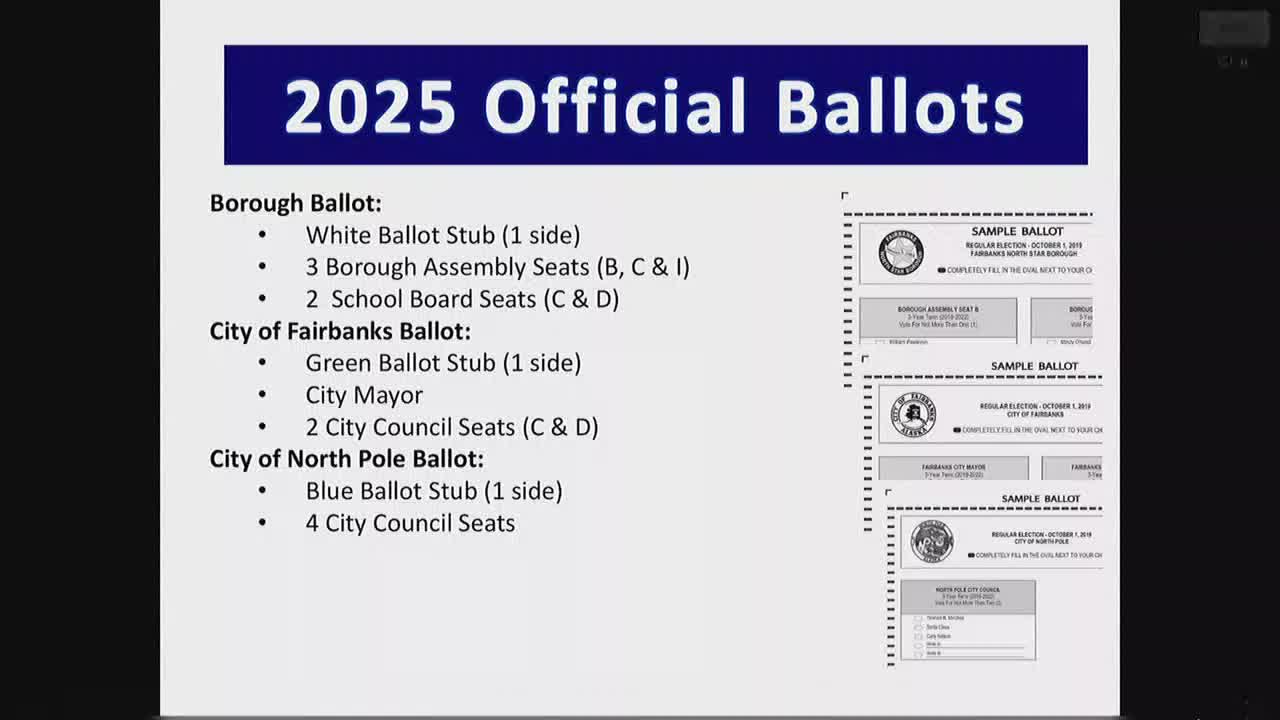
Clerk April Trickey told election workers the borough moved to one ballot stock this year and reviewed practical changes — new booths, split-precinct procedures, ID rules, question- and special-needs ballots, ballot-accountability steps and how to handle spoiled or duplicate votes.
April Trickey, borough clerk for the Fairbanks North Star Borough, told a room of election workers that the borough has moved to a single ballot stock this year to reduce end-of-night confusion and speed processing. "We did away with the extra ballot stock for question ballots this year," Trickey said, adding the change aligns borough practice more closely with the state and the change was made after consultation with the canvass board.
Trickey walked workers through practical steps for split precincts, ballot issuing and question ballots. In split precincts — Aurora, Fairbanks 2 and North Pole — workers must set two separate tables so only eligible voters receive the city ballot in addition to the borough ballot. If a voter’s name is not on the precinct register, workers were instructed to issue a question ballot and document the incident on the question-ballot oath and register.
On voter identification, Trickey reiterated state law permits a range of ID types and that a photo ID is not required. She listed acceptable documents including a voter card, Alaska driver’s license, hunting license or a printed Fish and Game receipt as valid forms of identification when the name and address match the register. For voters without ID who are "personally known" to workers, Trickey said workers may mark them personally known and allow voting without ID.
The training covered handling of spoiled ballots, duplicate votes and absentee returns. Workers were told to record and keep spoiled ballots and to place absentee-by-mail returns into the question-ballot envelope for precinct accountability. Trickey explained a common resolution for apparent duplicate votes: compare signatures using REMS (the state voter-registration database) and refer disputed cases to the canvass board for post-election review.
Trickey emphasized ballot-accountability steps to ensure nightly math reconciliation: record first and last stub numbers, count signatures in the precinct register (excluding question or special-needs envelopes), tally question and special-needs ballots, and complete the ballot statement before returning materials to the clerk's office.
The training included hands-on reminders about physical equipment: new standard and handicap voting booths require staff to check under removable plastic panels for campaign material even where curtains are absent, and workers were advised how to fold ballots into secrecy sleeves for question and special-needs voting.
Trickey closed by urging workers to call the borough clerk’s office if they encounter problems they cannot resolve on site, and to follow checklists exactly at opening and closing to protect ballot integrity.