
Experts and consumer advocates urge Michigan to adopt price‑transparency enforcement tied to collections in SB 95
Get AI-powered insights, summaries, and transcripts
Subscribe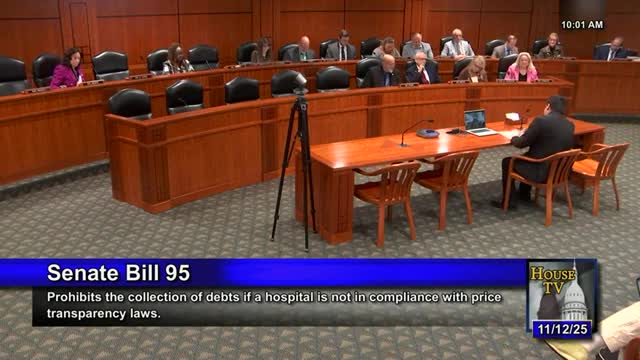
Summary
Experts and consumer advocates told the House Health Policy Committee that Senate Bill 95, which would tie enforcement of federal price‑transparency rules to hospitals' ability to collect medical debt, has improved compliance and consumer outcomes in other states and should be adopted in Michigan.
The House Health Policy Committee heard expert testimony in support of Senate Bill 95, which would strengthen Michigan enforcement of existing federal hospital price‑transparency rules and protect consumers from debt collection when providers are not in compliance.
Russell Jacobowski, executive assistant to Senator Jonathan Lindsey, framed SB 95 as a three‑part approach: require covered entities to comply fully with federal price‑transparency rules, codify those standards in state law, and prevent hospitals from pursuing debt collection when they were not in compliance at the time of service. "When patients and health care purchasers can see upfront prices, it allows them to shop and make meaningful decisions about where and how they get their care," Jacobowski said.
Two former Colorado legislators who helped enact similar laws in Colorado — Patrick Neville and Steve Fenberg — testified remotely. Neville described cases in which price transparency gave consumers recourse after surprise bills and enabled employers to steer employees to lower‑cost providers. "I was able to find an MRI that... was $400 rather than $3,800," Neville said, describing how consumer tools and employer incentives can produce large savings.
Steve Fenberg said Colorado's law produced near‑universal compliance and bipartisan support, and that SB 95 is narrowly designed to give patients recourse rather than impose new federal requirements on hospitals.
Alaria Santangelo of PatientRightsAdvocate.org said Michigan's compliance with the federal rule is low, citing a semi‑annual compliance review that found only two of 53 hospitals fully compliant, and urged the committee to adopt the bill. "If you don't show the price upfront, you shouldn't be able to collect afterwards," Santangelo testified.
Chris Deacon, former director of state health benefits for New Jersey, cited RAND research and state premium trends to argue transparency is essential to addressing price variation and rising premiums. He said targeted enforcement tied to existing federal obligations is a practical, narrow corrective that does not interfere with clinical judgment.
Committee members asked technical questions about shoppable services and machine‑readable files; witnesses said the federal rule already requires a list of 300 shoppable services plus a machine‑readable file of prices for all billed codes and that consumer tools can make those files usable.
The committee did not vote on SB 95 at this hearing; supporters said the bill has passed the state Senate in prior sessions and that if adopted it would give Michiganders more consumer protections against surprise medical bills.