Get Full Government Meeting Transcripts, Videos, & Alerts Forever!
Get email alerts on the Winchester Stormwater topic
No spam. Unsubscribe anytime.
Commission pauses dispute over Winchester dry-well requirement; applicant seeks broader remedy
Summary
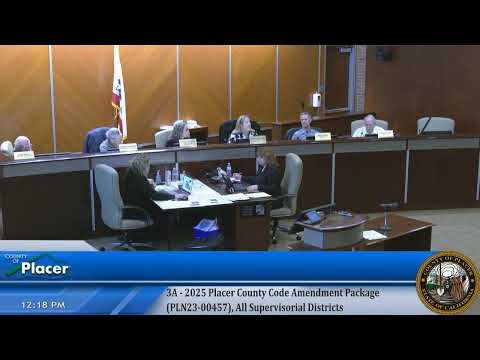
After heated testimony about a decades-old requirement for dry wells in the Winchester Subdivision, the Planning Commission agreed to continue consideration of a planning director—s determination that would allow alternatives (BMPs) to dry wells; the applicant asked for a continuance to pursue a fuller change in the subdivision—s conditions.
The Placer County Planning Commission took no final action on a contested planning director—s determination regarding stormwater methods in the Winchester Subdivision, instead continuing the item after the applicant requested more time to pursue a broader remedy.
Associate planner Jared Peters presented a staff recommendation that Condition of Approval 4 for the Winchester Subdivision may be satisfied by a range of on-site best management practices (BMPs) under the county—s West Placer stormwater quality design manual rather than prescribing dry wells exclusively. Peters told the commission the determination would allow the building services division, during building-permit review, to accept alternatives such as rain gardens, porous pavements, vegetated swales and disconnected downspouts where they meet the design manual—s standards.
The applicant (identified in staff documents as Jerry Johnson) and a long-time property owner recounted a 1993 sequence of hearings and asserted the Board of Supervisors voted to eliminate the dry-well requirement; the speaker who delivered the detailed historical account identified themself in the record as Sherry Johnson. That inconsistency in the transcript—s naming was raised during the hearing and remains a point of record (see audit note). The applicant argued property owners have been required to install dry wells for years, that soils in the subdivision do not percolate well, and that residents have incurred expense and property impact as a result. "I was forced to run a sewer line 5 miles through Christian Valley to the [treatment plant] because the property doesn't perk," the speaker said, describing decades-long efforts to resolve the issue.
Staff and county counsel clarified the planning director—s determination staff presented is an interpretation to allow alternative BMPs, not a formal elimination of Condition 4. County staff said stripping the condition would require a formal subdivision modification or amendment initiated by the owners or Winchester Community Association. "What is before you is a determination or interpretation from the planning director of alternative ways to satisfy that condition," planning director Chris Pahule said.
Winchester community representatives testified in support of allowing alternatives. David Nevin, representing the Winchester Homeowners Association, said the HOA historically required dry wells and that shifting to lot-level alternatives will raise pre-construction costs but may be appropriate; Wayne Nader, another owner, urged the commission to move the issue forward so property owners can get relief from failing systems.
After a brief recess and private consultation among the applicant, staff and county counsel, the applicant requested a continuance to pursue a "clean solution" involving county counsel and supervisors; the commission voted to continue the item (motion passed) to a date uncertain. The commission noted the decision may be appealed by those who participated in the hearing; appeal procedures and the $752 filing fee were stated on the record.
The record shows staff recommends the interpretation and implementation by building permit; whether the commission will endorse staff—s interpretation or seek a formal subdivision amendment remains pending pending further discussions and possible resubmittal.
Sources: staff presentation, applicant testimony, HOA and resident comments, planning director and county counsel clarifications recorded in the public meeting.