
Planning commission refines home‑occupation draft; direction to allow accessory garages, tiered outdoor storage and tougher sign limits
Get AI-powered insights, summaries, and transcripts
Sign Up Free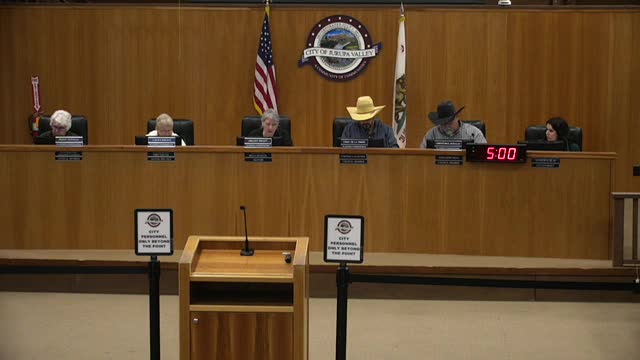
Summary
The Planning Commission reviewed and gave direction on a zoning code amendment to modernize home‑occupation rules, including allowing enclosed garages/accessory structures for business use when parking is retained and adopting a two‑tier system for outdoor storage and vehicle allowances on larger lots.
The Planning Commission reviewed a draft municipal code amendment to clarify and modernize rules for home occupations and returned comprehensive direction to staff. The commission treated the session as a study meeting and asked staff to return a revised ordinance for a continued public hearing on January 14, 2026.
Tom Gorham (Community Development staff) presented a line‑by‑line synthesis of prior commission comments and recommended approaches. Staff recommended permitting home‑occupation activity within a legally permitted, fully enclosed garage or accessory structure if the residential character is maintained and required residential parking spaces remain available. Staff also proposed a two‑tier approach tied to lot size (20,000 square feet as a commonly‑used threshold): smaller lots (under 20,000 sq ft) would be limited to indoor activity and screened outdoor equipment/storage not exceeding 100 sq ft, while larger lots (≥20,000 sq ft) could permit an outdoor work area up to 10% of the lot and larger screened equipment/storage (up to 200 sq ft).
Commissioners agreed staff should align vehicle‑weight and commercial‑vehicle definitions with California Vehicle Code thresholds, allow one non‑resident employee for small lots and up to two for larger lots, and develop objective screening standards (opaque or solid screening; slats in chain‑link acceptable if they create an opaque appearance). Commissioners also reached consensus to remove the small lawn‑sign allowance (staff had proposed a non‑illuminated 2‑sq. ft. sign) to avoid visual clutter; staff will prohibit new home‑occupation signage in multi‑family settings.
The commission directed staff to prepare a hardship/exemption process (recommended as a discretionary, annually reviewed exemption to the Planning Commission or delegated to the Community Development Director with annual monitoring) to handle exceptional circumstances without creating permanent variances that run with the land. Staff will reconcile existing municipal provisions that prohibit commercial vehicles over 10,000 pounds from parking on residential streets with the new allowances for on‑site business vehicles, and will return with recommended objective hours of operation (staff suggested 10 p.m. as a likely upper limit for client visits).
The commission did not take a final vote and continued the matter to a noticed hearing on Jan. 14, 2026; staff will incorporate the commission's direction (garages/accessory use standards, lot‑size tiers, vehicle and employee caps, removal of sign allowance, screening standards, hardship exemption language and hours of operation) and return with updated ordinance language and public noticing.