Get Full Government Meeting Transcripts, Videos, & Alerts Forever!
Get email alerts on the Shared Use Paths topic
No spam. Unsubscribe anytime.
Commission supports DOT ADA/shared-use path resurfacing project for Steves Highway and Phillips Field
Summary
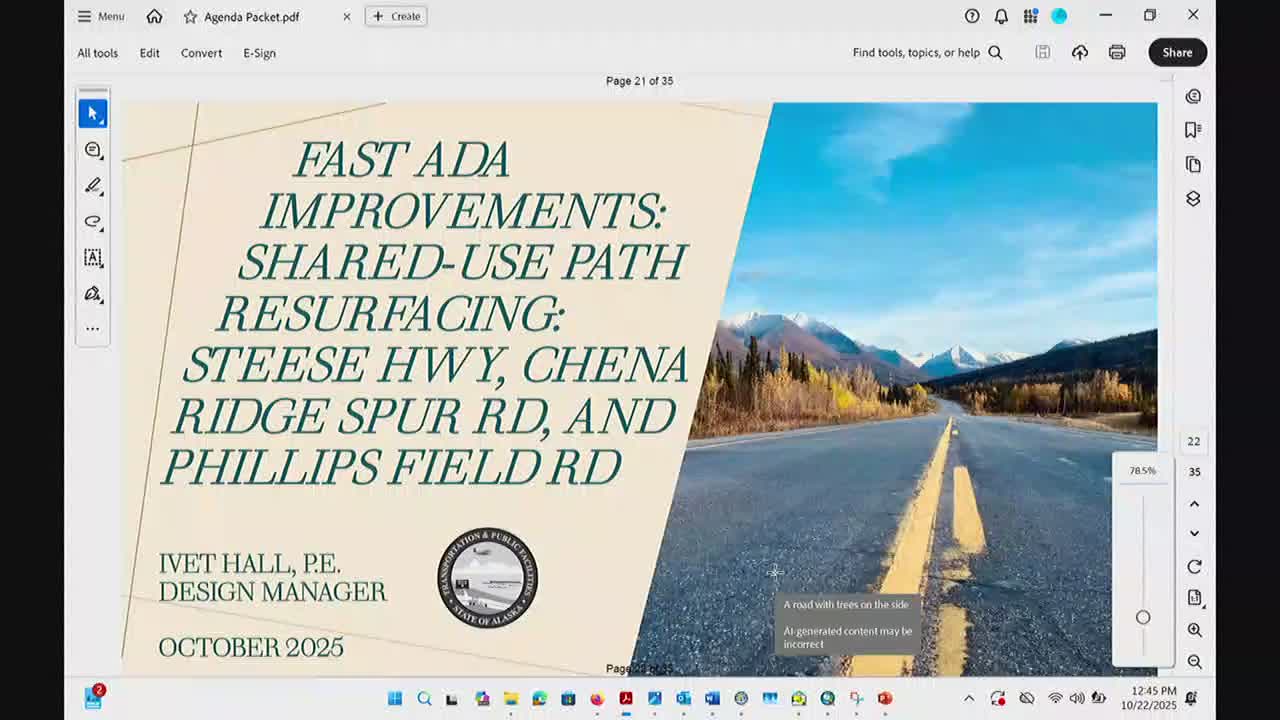
The commission voted 5–0 to back DOT’s FAST ADA Improvements shared-use path resurfacing project (NFHWYO1102), which would widen paths in multiple locations, replace noncompliant curb ramps and schedule construction in 2026; staff said river-adjacent segments will be widened away from the ordinary high-water mark where possible.
The Chena Riverfront Commission on Oct. 22 unanimously expressed support for the Alaska Department of Transportation and Public Facilities’ FAST ADA Improvements Shared-Use Path Resurfacing Project (NFHWYO1102), a package of resurfacing and widening work scheduled for construction in 2026.
Anthony Hunt, an engineering assistant on the project team, told the commission the overall effort focuses on widening existing path sections (targeting 8–11 feet where feasible) and replacing curb ramps that do not meet current ADA standards. “We’re going to widen the existing paths that are currently 5 to 7 feet to 8 to 11 feet,” Hunt said in his presentation, and he confirmed the current construction schedule is 2026.
Project geography includes three locations: Chena Ridge/Chena Spur Road, Phillips Field Road (widening where possible toward a 10-foot target), and a Steves Highway segment that runs near the river. Staff said where right-of-way is constrained — for example by utility poles or narrow property lines — some segments may remain narrower and the team will attempt a minimum of 8 feet in those places. For the Steves Highway section that sits within 150 feet of the ordinary high-water mark, design will prioritize widening away from the river and repairing fencing where needed.
Annette Freiburger moved that the commission express support for the NFHWYO1102 project; Julie Jones seconded. The motion passed by roll call, 5–0.
Why it matters: the work addresses ADA compliance and safer, wider shared-use paths in segments that feed the riverfront and nearby neighborhoods; it also clarifies design limits where right-of-way and utilities constrain widening.
What’s next: DOT staff will continue design work and coordinate required right-of-way and maintenance questions; the commission’s action is advisory support to DOT.