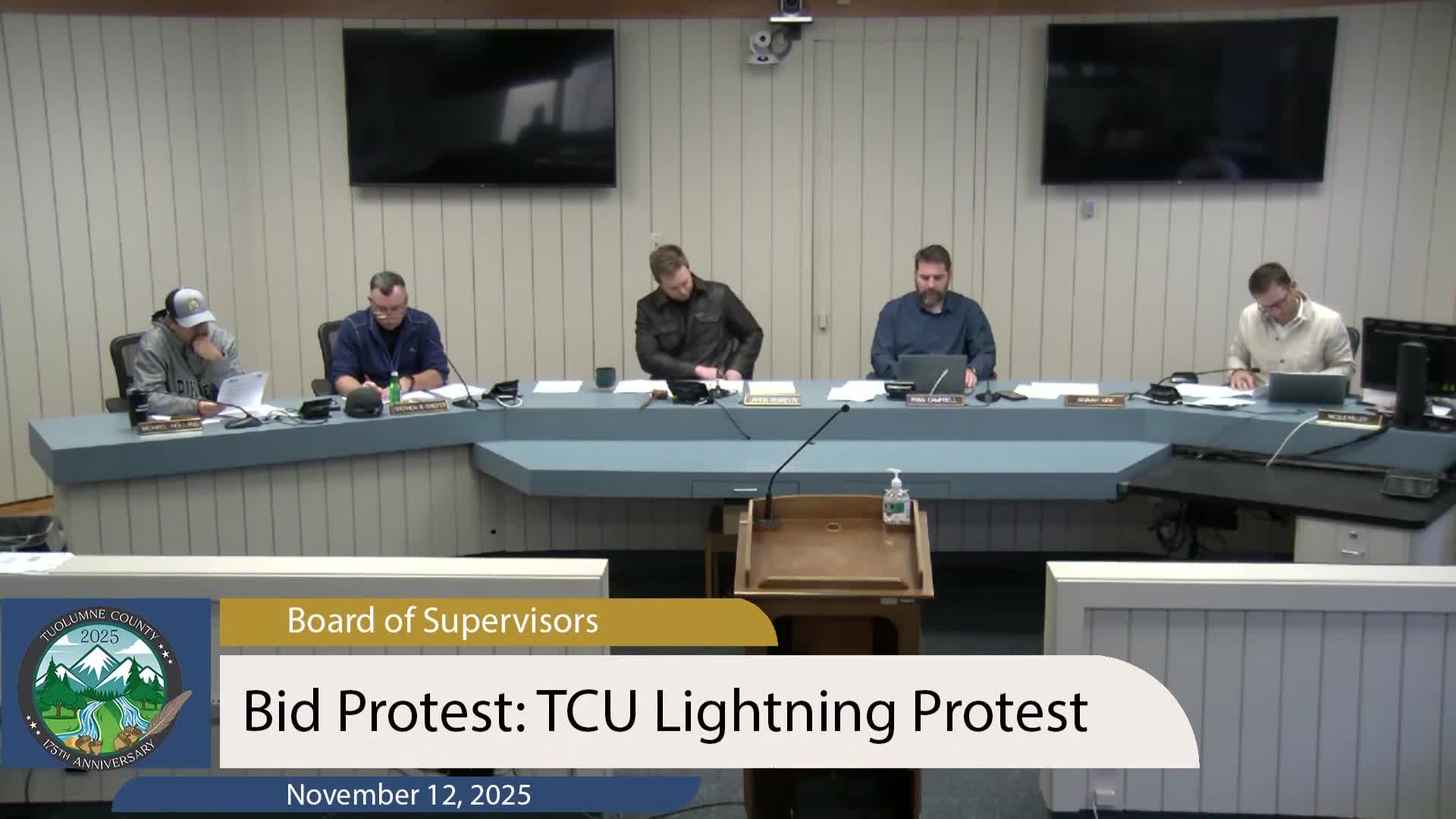
Tuolumne County awards $1.89 million wildfire debris-removal contract to Anvil Builders; rejects bid protest
Loading...
Summary
Tuolumne County’s Board of Supervisors voted unanimously on Nov. 12, 2025 to award a $1,893,350 contract to Anvil Builders for Phase 2 lightning-complex disaster debris and hazard-tree removal and to approve related budget and contracting actions.
Tuolumne County’s Board of Supervisors voted unanimously on Nov. 12, 2025 to award a $1,893,350 contract to Anvil Builders for Phase 2 lightning-complex disaster debris and hazard-tree removal and to approve related budget and contracting actions.
Blossom Scott Heim, director of public works, told the board that the county received eight bids for the DDHTR (disaster debris and hazard tree removal) contract and that county counsel and staff had reviewed the low bid from Anvil Builders and found it “in substantial compliance with our call for bids.” Heim said the county received a protest from Sierra Mountain Construction Inc. (SMCI) alleging an incomplete or unbalanced bid, but staff concluded the alleged issues were not material and recommended rejecting the protest and waiving the irregularities so the county could award to Anvil.
The motion read into the record by staff directed the board to: find the SMCI bid protest had “insufficient merit” and reject it; waive irregularities in Anvil Builders’ bid; award contract number 1787 to Anvil Builders in the amount of $1,893,350 and authorize the chair to sign; increase FY 2025–26 recovery appropriations by $3,650,000, recognize $3,285,000 in state disaster revenue, and reduce general fund contingencies by $365,000 (a four-fifths approval action); approve the County Administrator to sign a user agreement with Tetra Tech Inc. under the state Master Services Agreement; and authorize the Director of Public Works to take necessary implementation steps.
Heim provided additional contract context: the county selected Tetra Tech under the state master services agreement for assessment and monitoring work (a user agreement totaling $1,634,362.33), and she said Tetra Tech began assessments on Nov. 10, 2025. Heim told supervisors that Cal OES is expected to reimburse approximately 90% of debris-removal costs, leaving an estimated 10% county match. “It is anticipated that Cal OES will reimburse the county for 90% of the cost of debris removal,” Heim said.
Supervisors pressed staff on procurement safeguards. Supervisor Holland asked counsel to explain the difference between a “minor deviation” and a “material deviation”; counsel explained a minor deviation “would not have affected the bid price, ... would not give any bidder a competitive advantage, and ... would not impede the county’s ability to compare bids.” Public works staff described how unbalanced unit pricing is assessed against the average of the eight bids and said the large spread among bids is typical for disaster debris work because of staffing and equipment variables.
Supervisor Kirk disclosed a past campaign contribution from Doug Benton, the owner of SMCI, and asked whether that affected SMCI’s ability to bid; staff said any firm may submit a bid and that SMCI had submitted a bid but county staff would review whether it met the stated qualification (two DDHTR projects of at least $2 million within the last five years).
During public comment, Carly Keane of Cowways — a local Sonora trash hauler — said Cowways will partner with Anvil on the Chinese Camp project and noted the company has “10 years of experience in fire debris removal.”
After staff read the motion aloud, a supervisor moved and Supervisor Campbell seconded. The board voted “aye” with no opposition or abstentions recorded; the chair announced, “It passes unanimously.”
The board’s actions (award, budget adjustments and user agreement approval) are intended to accelerate Phase 2 cleanup work for properties affected by lightning-caused fires, including the Chinese Camp Fire. Staff said the county has approximately five days remaining in the IFB’s 60-day award window and warned that rejecting the low bidder and conducting a deeper responsiveness review could delay work into winter.
What’s next: staff is authorized to execute the contract and take steps necessary to implement debris-removal operations; the Tetra Tech user agreement is in place for assessment and monitoring work that has already begun.