Get Full Government Meeting Transcripts, Videos, & Alerts Forever!
Get email alerts on the Arts And Culture topic
No spam. Unsubscribe anytime.
Encinitas reviews first year of Pacific View Arts Center; council asks commission for vision and entitlement options
Summary
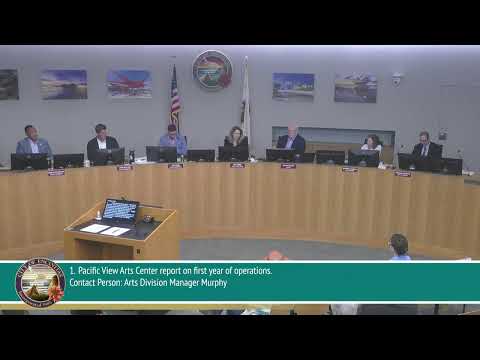
The Encinitas City Council and the city's Commission for the Arts met in a special joint session to review Pacific View Arts Center's first year of operations and to set next steps for programming, budgeting and potential changes to the property's entitlements.
The Encinitas City Council and the city's Commission for the Arts met in a special joint session to review Pacific View Arts Center's first year of operations and to set next steps for programming, budgeting and potential changes to the property's entitlements.
Staff told the joint meeting that Pacific View opened to the public on Aug. 13, 2024, and operated about 10 months in fiscal year 2024-25 with incremental expansions in hours and rooms. The report presented room uses, program activity and initial finances: 509 programs were offered (222 held), roughly 805 class sessions, 1,589 unique enrollees and 6,135 total attendances; about 75% of participants were Encinitas residents. Staff said program revenue totaled about $175,276 and flagged roughly $186,213 in facility-related costs that were run through other department budgets.
City staff explained operations followed the city's recreation model, which does not aim to recover full facility costs. "Classes at Pacific View recovered about 33%" in the first year, staff said, noting comparable recreation programs typically recover between 25% and 60% depending on format. Staff estimated one-time startup expenses under $50,000 (furniture and small capital items) and projected additional earned revenue next year with a full summer of camps and expanded programming.
Council members pressed for clearer profit-and-loss accounting that includes all costs tied to the facility. Council members asked staff to separate one-time capital outlays (for example, installations) from recurring operating costs so future budgets reflect what will remain as ongoing obligations. Council member Schaeffer said accurate numbers are needed to oversee the center's long-term sustainability while also pursuing creative programming to grow attendance.
On debt and mortgage questions, City Manager (as reported in the meeting) identified the Pacific View debt payment as $560,000 a year and staff previously referenced the bond principal as approximately $345,000. Council members and staff agreed the city should present a fuller P&L-style accounting (including debt service and other central costs) in future reports so the council can measure cost-per-pupil and other operational metrics.
Public commenters and instructors framed Pacific View as a community asset with strong intangible value. Instructor Natalia Quintero described the center as "a safe space where the community can gather," and artist Rosemary Kimball said the facility was not designed to be self-funding given room sizes and occupancy limits. Resident speakers and arts advocates urged more marketing, outreach and private philanthropic support; several suggested a Friends-of-Pacific-View nonprofit to help fundraising and visibility.
The council and commissioners discussed zoning and occupancy limits as practical constraints. Staff and planning representatives explained the current business classification and the factors that control occupant load and allowable uses (restroom fixtures and parking among them). Changing entitlements to allow additional uses or higher occupancy would likely require discretionary review and an entitlements process; the council asked planning staff to join upcoming Commission for the Arts discussions to explain that pathway.
Deputy Mayor Lyons asked the Commission for the Arts to return with a clear vision and a range of feasible options for the property, including programmatic, permit and funding approaches for the next 3 to 5 years. Council members suggested treating the next two to three years as learning years while pursuing marketing, consistent programming and opportunities to activate outdoor spaces for community events.
Staff offered examples of adaptive programming already underway: after a drum group raised noise complaints at a park, staff invited them to perform at Pacific View, and that association spawned a new class offering. Commissioners emphasized youth engagement, school-district partnerships and exploring legacy society or other philanthropic options.
No formal motions or council votes were recorded at the meeting. The council directed the Commission for the Arts and relevant departments to return with a recommendation that outlines possible entitlement changes, a clarified P&L including debt service, and a strategy to increase utilization while preserving affordable and accessible programming. The meeting adjourned with plans to continue budget and policy work in the coming months.