
Utah Main Street webinar: How to weave brand identity into historic building renovations
Get AI-powered insights, summaries, and transcripts
Subscribe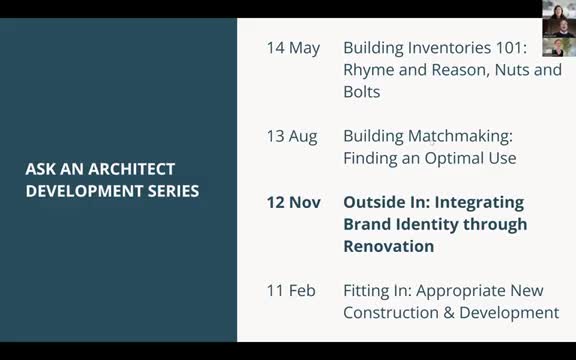
Summary
Janssen, a presenter for the Ask an Architect webinar series produced by Utah Main Street, told attendees that brand is more than a logo and should "evoke an emotional connection with consumers."
Janssen, a presenter for the Ask an Architect webinar series produced by Utah Main Street, told attendees that brand is more than a logo and should "evoke an emotional connection with consumers." The online session walked building owners and Main Street stakeholders through how to translate two-dimensional identity systems into the three-dimensional experience of a storefront or interior.
The talk began with practical framing: Janssen said owners should first identify who they are, what makes them unique and who their customers are. That groundwork, she said, reduces the risk of spending on changes that don’t align with a business’s mission or audience. "A good brand should evoke an emotional connection with consumers," Janssen said, noting that brand elements include mission, values, typography and color as well as physical materials.
Janssen pushed owners to distinguish between permanent and impermanent building elements. Permanent elements such as structure, windows and life-safety systems should be neutral and meet functional needs; impermanent elements — paint, furniture, light fixtures and artwork — are where owners can express identity affordably and reversibly. "The impermanent elements are where you want to focus your brand identity, the most," she said.
To make the ideas concrete, Janssen used corporate and adaptive-reuse examples. She reviewed a new-build Starbucks floor plan to show how lighting, wood paneling and counter placement prioritize customer touchpoints, and described the Starbucks Roastery in Seattle as an adaptive-reuse case that preserved character-defining features (large historic openings, terracotta detailing, cornice line) while making selective, compatible changes to signal the brand.
She also led a case-study exercise of a 1887 two-story commercial building in Dubuque, Iowa (1486 Central Avenue), noting building specifics offered to attendees: 1,300 square feet of commercial space plus a roughly 1,000-square-foot rear addition, original hardwood floors and a pressed tin ceiling to retain. For a proposed tenant, Reading in Public (an independent bookstore-cafe), Janssen suggested modest exterior refinements (adjusting paint color, updating address-typeface and limited signage) and interior moves (back-wall wood paneling, furniture and rotating artwork) that preserve character while reinforcing the tenant’s minimal, people-centered brand.
Attendees also raised questions about historic-district listings and funding. In response, Janssen clarified the difference between National Register and local historic designations. "National Register listing does not bring any kind of red tape or any requirements," she said, adding that the designation is honorary but can "open the door for a wide variety of financial incentives" such as state-administered grants and tax-credit programs. By contrast, local historic districts may impose review and zoning requirements — for example, a landmarks commission review — which can constrain exterior changes. Janssen advised owners listed in both national and local registers to consult the state for incentives and their city for review processes.
When asked whether Utah Main Street currently provides the kind of illustrative mockups shown in the presentation, Janssen said detailed graphic renderings are not yet a standard service. She said staff can meet with owners to discuss design goals and that offering applied visual services is being explored for the next fiscal year on an application basis, given limited staffing.
The session closed with Janssen sharing contact information and inviting attendees to propose topics for future Ask an Architect webinars. She emphasized that small, well-targeted changes to impermanent elements can deliver significant perception shifts while protecting the character-defining fabric of historic districts.
Next steps noted in the webinar: owners interested in financial incentives should contact the state office about grants and the tax-credit program; property owners in local historic districts should check municipal review requirements before making exterior changes.