County manager presents balanced 2026 budget with no tax increase, seeks efficiencies and premium changes
Loading...
Summary
County Manager John Fornier told council the FY26 proposal contains no tax increase and is balanced, outlines $1.8M in savings from closing funded vacancies, changes to employee health-premium structure, cost-containment measures and planned bond sales; councilors probed staffing at county nursing centers and public-transit exposure.
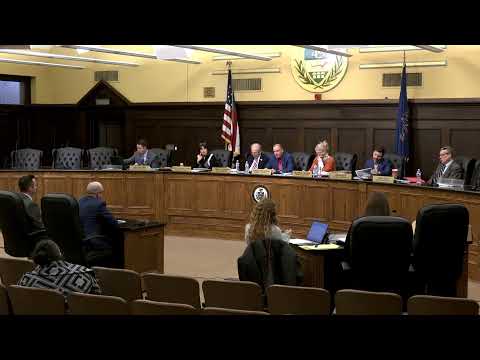
County Manager John Fornier told Allegheny County Council on Wednesday that the administrations proposed 2026 operating budget will not include a tax increase and is balanced on paper, but will rely on a series of cost-containment measures and structural changes to maintain fiscal stability.
"There will be no tax increase requested this year in the budget," Fornier said at the public hearing. He described a conservative 1.52% overall budget growth rate and said new initiatives are being funded by cuts elsewhere.
Fournier outlined a package of measures intended to slow spending growth: removing a large number of unfunded positions from the personnel plan, closing about 35 funded positions that have been chronically vacant (estimated savings ~$1.8 million), rebidding large contracts, centralizing IT to cut redundant licensing, and conducting a benefits audit that removed roughly 250 ineligible dependents from the county health plan.
On employee health coverage, Fornier said the county will change the premium structure for nonunion employees, effective Jan. 1: premiums will be 1.2% of base salary plus a fixed monthly charge by plan (he cited $41 for individual coverage, $81 for employee-plus-spouse, $131 for employee-plus-child and $181 for family coverage). He said bargaining is ongoing with union groups and conversions will follow agreements. "Starting January 1 for all nonunion employees, we are changing the premium structures... 1.2% of their base salary plus an additional fee depending on the plan selection," he said.
Fournier also highlighted the administration's approach to long-term care centers (the Cane community living centers), saying the county is reducing reliance on higher-cost agency nurses through rebidding and hiring internal staff while keeping staffing above state minimums. That exchange drew pushback from council members who argued extra agency shifts had historically been used for scheduling flexibility; Fournier said the changes are designed to reduce contractual expense and bring more staff in-house over time.
Debt and capital: Fornier said Moody's affirmed the countys bond rating at double-A3 with a stable outlook but warned that failing to rebuild the general fund balance could risk a downgrade. The administration plans a $66 million bond sale this year and anticipates another $78 million borrowing in 2027 to support capital projects; Fornier also said the county will explore a bond-refinancing opportunity in 2026 to reduce debt service.
Intergovernmental exposure: Fornier told council that federal and state budget impasses have forced the county to front roughly $150 million in costs it expected to be reimbursed; in response, the administration will maintain hiring and discretionary-spending freezes through the end of the calendar year to protect cash flow.
Council members pressed Fornier and Budget Director Tim Cox on several items: the scale of proposed funded-position closures, specific capital projects tied to the carbon-neutrality plan, whether the county can step into transit funding gaps if the Commonwealth reduces Port Authority support, and further details about staffing mixes at long-term-care centers. Fornier said detailed data (including staffing-ratio statistics and project plans) are available and offered to follow up with council offices.
Whats next: The administration said it will send legislation to adjust administrative fees and will bring detailed capital and bond proposals to council for approval when market timing and project scopes are finalized. No votes were taken at the hearing.
Sources: Presentation and Q&A with County Manager John Fornier and Budget Director Tim Cox at the Allegheny County Council public hearing on the 2026 budgets.