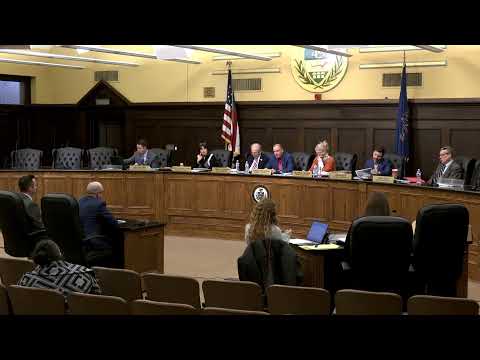
CCAC tells Allegheny County council it serves 30,000 students and seeks a modest 2% funding increase
Loading...
Summary
Dr. Bullock, a Community College of Allegheny County (CCAC) official, told Allegheny County Council on Wednesday that CCAC serves about 30,000 students across four campuses and three centers and emphasized the colleges role in workforce training and transfer pathways.
Dr. Bullock, a Community College of Allegheny County (CCAC) official, told Allegheny County Council on Wednesday that CCAC serves about 30,000 students across four campuses and three centers and emphasized the colleges role in workforce training and transfer pathways. "The college, as you know, serves about 30,000 students across 4 campuses in 3 centers," he said.
The presentation, led by Dr. Bullock with finance vice president Cathy Jacobs, laid out enrollment and outcome data the college said underpin its funding request. Dr. Bullock cited a recent economic-impact study and student outcomes, saying most CCAC graduates live and work in the county and that nursing graduates have high postgraduation placement rates. "92 percent of our nursing program graduates have jobs within the first 6 months," he said.
Jacobs summarized CCACs revenue mix and the colleges budget assumptions, saying the operating budget relies on tuition, state aid and county appropriations and that workforce-development noncredit courses account for a growing revenue stream. She told council the college is planning to request a roughly 2% increase in county support for fiscal 2026-27 and that the request includes about $3.75 million earmarked for debt service. "We are requesting a 2% increase... and that does include the 3.75 for the debt service," Jacobs said.
Why it matters: Council appropriations comprise a material portion of CCACs operating and capital support, and the college emphasized both student affordability and local workforce supply as reasons for continued county backing.
Council members pressed for specifics about partnerships and metrics. Councilwoman Filiaji asked whether CCAC's 40-plus articulation agreements are within Pennsylvania; Dr. Bullock said the formal articulation agreements are with Pennsylvania institutions while students have transferred to a broader set of schools by choice. "The clear articulation agreements that are in place are the Commonwealth of Pennsylvania," he said. Several council members asked about clinical placements at county facilities and whether county hospitals or the jail could be stronger partners for nursing placements; Dr. Bullock said CCAC would follow up to explore direct placement opportunities.
Council members also probed workforce-development revenue and program examples; Jacobs and Dr. Bullock described paramedic, EMT, CDL and short-term industry training as contributors to noncredit revenue, which the college projects at approximately $3.5 million annually. On affordability, the presenters highlighted CCACs tuition advantage: the packet shows a per-credit tuition and fee figure (transcript figures are garbled in places), and the college said its in-state tuition remains among the most affordable in the Commonwealth.
Council praise was frequent: "You had me at the Center for Innovation," Councilwoman Filiaji said during a round of compliments, and other members urged CCAC to pursue partnerships that could increase county hires from CCAC cohorts.
The college also described recent capital and classroom investments funded with county assistance, including nursing-space renovations on the North Campus and a new Center for Education, Innovation and Training that supports culinary arts, mechatronics and health programs.
Whats next: CCAC concluded by saying staff would follow up on specific placement data and partnership ideas; the college also asked for the requested county appropriation in the annual budget review process.
Sources: Presentation and Q&A with Dr. Bullock and Cathy Jacobs at the Allegheny County Council public hearing on the 2026 operating and capital budgets.