
Commission defers shared‑streets ordinance after questions on transit coordination and pedestrian protections
Get AI-powered insights, summaries, and transcripts
Sign Up Free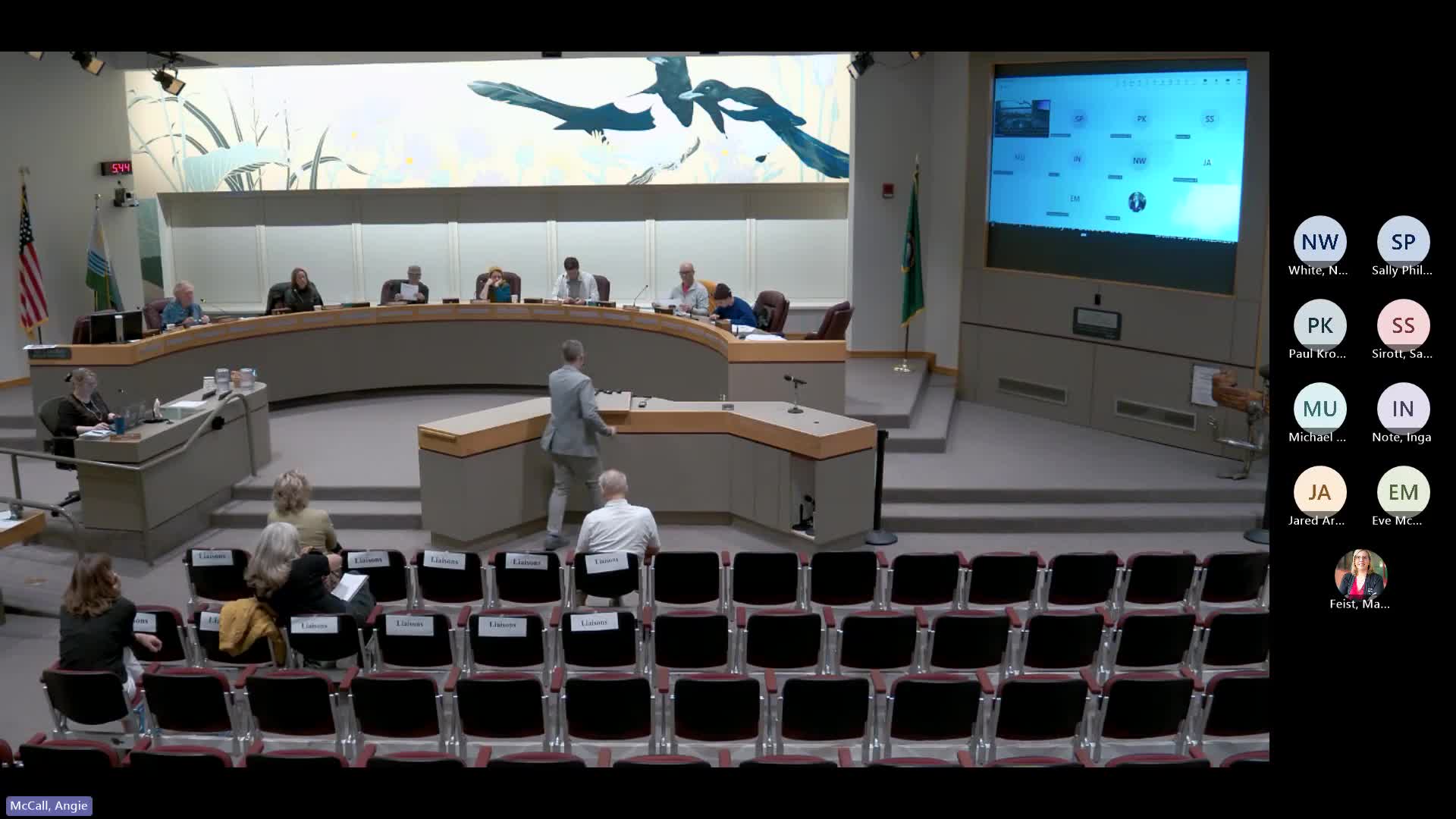
Summary
After a public hearing and substantial deliberation, the Transportation Commission voted to defer a proposed shared‑streets ordinance until next month, asking staff to remove STA transit‑route language, clarify criteria for pedestrian protections and return with additional outreach and refined language.
The Transportation Commission held a public hearing Oct. 15 on a proposed shared‑streets ordinance meant to align Spokane Municipal Code with recent state law that enables shared‑street designations. The draft grants authority for 10‑mph shared‑street designations and establishes a yield hierarchy that places pedestrians first, micromobility second and motor vehicles third.
City staff described candidate streets (the east end of Ben Burr, Sherman Street in the University District and parts of Wall Street) and the ordinance’s criteria for speed limits and yield-of-right-of-way. Emily Poole, interim planning chief at Spokane Transit Authority, testified during public comment and asked the commission to remove language that would allow shared-street designations on streets that serve transit routes. "We would ask that that language be removed," Poole said, citing safety and best-practice coordination around transit movements.
Commissioners debated: whether the draft sufficiently protects pedestrians (especially those with vision loss), how micromobility enforcement would work, whether additional candidate downtown streets should be considered, and whether Sherman and Wall should be excluded if transit routes use them. One commissioner moved to consider the ordinance; a later motion to defer carried after deliberation. At roll call the chair voted to defer; multiple commissioners voted yes, one commissioner voted no and at least one abstention was recorded. The chair said staff will return with the ordinance amended to remove STA transit-route language for now, clarify the factors that qualify a street as shared and include more outreach and examples of potential downtown candidates.
What’s next: the commission directed staff to coordinate further with STA, refine pedestrian-protection criteria (e.g., planters or delineated pedestrian zones), and return with amended language and outreach results at the next meeting.