Get Full Government Meeting Transcripts, Videos, & Alerts Forever!
Get email alerts on the Facilities topic
No spam. Unsubscribe anytime.
PYLUSD outlines $61 million in completed and in‑process facilities work and launches master plan RFP
Summary
District facilities staff presented roughly $35 million in recently completed projects and $26 million in work under way, outlined funding limits (developer fees, Fund 40, deferred maintenance) and recommended a ~$1 million facilities master plan (FMP) that must be completed before applying for Prop 2 state matching funds.
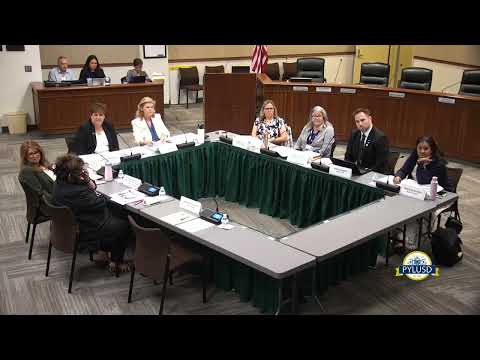
Joan Velasco, the district facilities lead, told the Placentia‑Yorba Linda Unified School District Board of Education on Oct. 21 that the district has completed nearly $35 million in capital projects and has about $26 million currently in process across schools from preschool portables to athletic field work.
Velasco said routine maintenance is funded from a restricted maintenance account set at 3% of general fund expenditures—about $11 million annually—of which roughly $6 million pays staff salaries and about $5 million pays repairs; deferred maintenance transfers $1.5 million per year into Fund 14. She also warned that developer fees (Fund 25), which bring in roughly $400,000 per year, will taper because the district is largely built out, and that a special reserve (Fund 40) tied to a City of Yorba Linda settlement will stop providing funds after the 2025–26 year.
The presentation listed school‑level projects and expected completion timelines: Fairmont TK restrooms (~$700,000, Aug. 2026); George Key flooring (~$60,000, May 2026); Golden TK restrooms ($700,000) and kitchen cabinet removal ($30,000); Topaz expanded‑learning portables ($2.4 million, Nov. 2025); El Dorado and Valencia synthetic turf replacements (El Dorado ~$4.65 million; Valencia ~$650,000, both on summer timelines); Valencia kitchen modernization (~$6.3 million, phased 2026–27); and multiple kiln and bleacher replacements and parking/track resurfacing projects.
Board members pressed staff about rising cost estimates for Valencia’s kitchen modernization; Ralph (facilities staff) and the project team said costs grew during design development once architects’ cost estimators refined initial numbers, and that options for value engineering remain under consideration. Max Van Demortel, maintenance and facilities, described standard hazardous‑materials testing and the downstream repair work that can arise when cabinets and walls are opened.
Velasco recommended the district issue an RFP for an external firm to prepare a facilities master plan (FMP), estimated at about $1 million and expected to take roughly 12–18 months. She said the FMP will include building condition assessments, life‑cycle analyses, capacity/utilization studies, ADA and DSA compliance reviews, and a weighted scoring matrix to objectively rank projects and integrate them into a multiyear capital budget.
Velasco also discussed state funding through Proposition 2, passed in 2024, which authorized $10 billion in K‑12 and community college bonds but requires a completed FMP and local matching funds. "A significant portion of Prop 2 funding will go toward backlog projects," she said, and awards are made on a first‑come, first‑served basis; that could leave districts without an FMP behind in competition for funds.
The board directed staff to return to the December meeting with the RFP for board approval so the FMP work can begin. Velasco closed by thanking facilities staff and reminding trustees that safety and high‑priority needs will guide project sequencing.