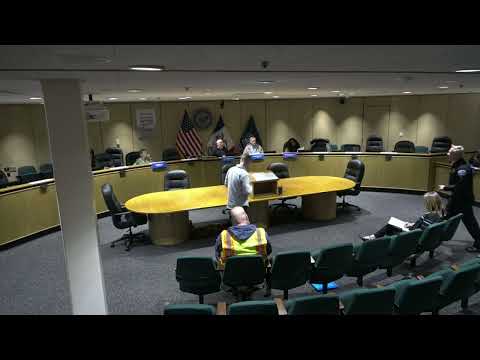
Veil Service Commission approves new civilian public-safety supervisory roles
Get AI-powered insights, summaries, and transcripts
SubscribeSummary
The commission approved multiple new civilian positions — including supervisors for crime analysis and digital forensics, an upgraded lead police services generalist role with interpreter certification, and a legal projects coordinator — to strengthen Davenport’s data, forensics, and records capacity.
The Veil Service Commission voted to approve a package of new civilian positions aimed at expanding the city’s data and technical capacity in public safety, including a Crime Analysis Unit supervisor and a Digital Forensics Unit supervisor.
Staff described the Crime Analysis Unit supervisor as a promotional civilian position that “provides strategic oversight of the unit, manages crime analysts, and ensures the effective use of data driven policing strategies.” Police Chief Jeff Laidle said the supervisor will develop dashboards and training that support real-time, data-driven operations, noting, “This person is the one that develops our dashboards … that actually help us with our data driven real time information.”
Presenters said the position requires a bachelor’s degree in criminal justice, computer science, statistics, research analysis, data science or a related field and about five years of relevant experience or an equivalent combination of training and experience. The presentation also noted the role calls for a certified law enforcement analyst credential (described in the presentation as “CLIA” or an equivalent crime analysis certification as approved by the police chief).
The commission also approved a Digital Forensics Unit supervisor position, described by staff as a promotional civilian role responsible for hardware and software analysis, forensic imaging, data recovery from cellular phones and other media, preparation of materials for court, and appearing as an expert witness. Staff said candidates should have a bachelor’s degree that includes coursework in digital forensics and at least three years of related work experience, plus a CFCE (Certified Forensic Computer Examiner) or equivalent certification.
Separately, the commission approved updates to minimum qualifications for a lead police services generalist, including the addition of state court interpreter certification and NCIC certification as continuing requirements; staff clarified the lead role is distinct from a supervisor and focuses on higher-level interpretation, training, and records work that supports frontline PSGs.
Gina, a city staff presenter, introduced a new legal projects coordinator position in the legal department to manage open-records requests and legal administrative projects; the coordinator must complete Iowa Public Information Board training per Iowa law within 90 days, carry out records-management duties, pass a background check, and meet a residency requirement.
A commissioner asked whether sworn officers could fill these specialist roles; presenters said the positions are intended as civilian promotional tracks to retain specialized, technical staff and reduce turnover from rotating sworn officers into niche assignments. The package of new positions was approved by a motion and voice vote.