
Judge Stephanie Boyd opens voir dire in aggravated‑assault case; jurors briefed on burden, self‑defense and punishment range
Get AI-powered insights, summaries, and transcripts
Sign Up Free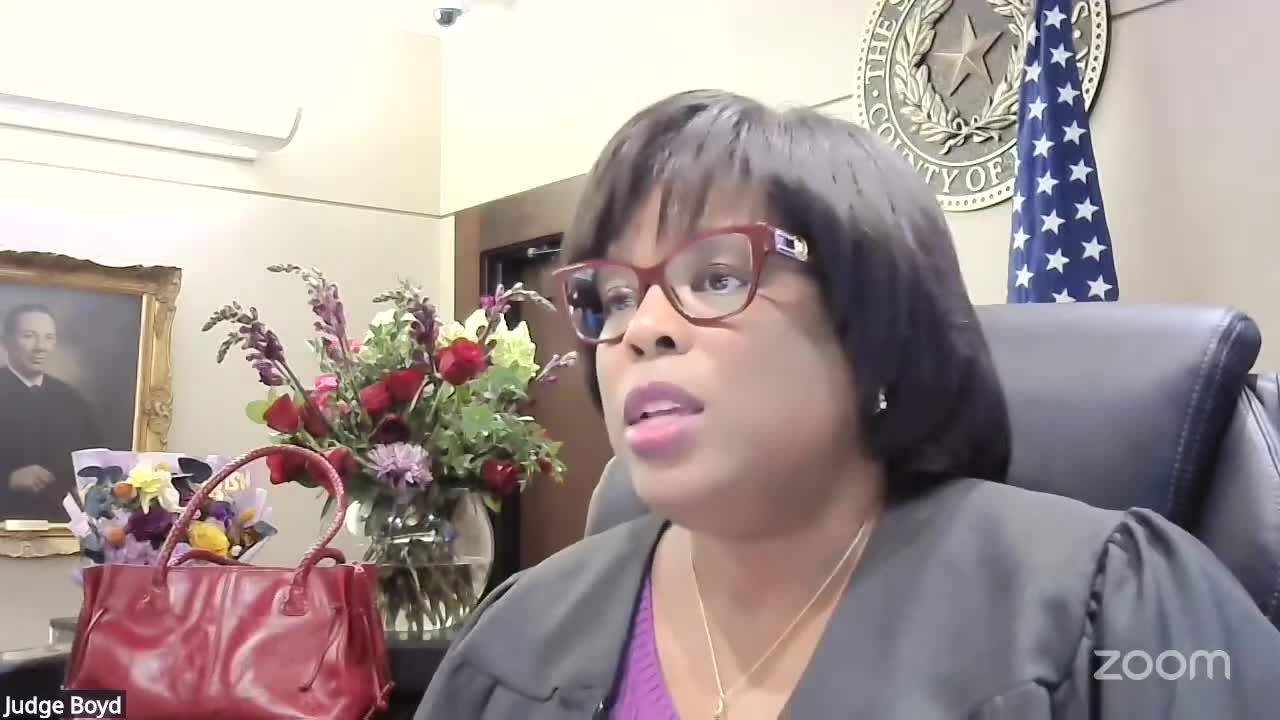
Summary
Judge Stephanie Boyd of the 187th District Court began jury selection in State v. Johnny De La Rosa on the court’s fourth floor, telling prospective jurors that an indictment ‘‘is not evidence of anything’’ and reminding them of the constitutional right to remain silent.
Judge Stephanie Boyd of the 187th District Court began jury selection in State v. Johnny De La Rosa on the court’s fourth floor, telling prospective jurors that an indictment ‘‘is not evidence of anything’’ and reminding them of the constitutional right to remain silent. The case is charged as aggravated assault with a deadly weapon; the judge told the panel the first phase of trial addresses whether the state proved guilt beyond a reasonable doubt and that the second phase, if reached, concerns punishment.
State prosecutors Megan Galloway and Lauren Espinosa explained the elements the state must prove: the offense date, that the offense occurred in Bexar County, that the defendant was the actor, and the mental state (intentionally, knowingly or recklessly) that caused bodily injury while using or exhibiting a deadly weapon. ‘‘We are looking for jurors who can follow the law and base decisions on the evidence,’’ Galloway told the panel during voir dire.
The court walked jurors through hypotheticals to probe views on self‑defense and verbal provocation. Judge Boyd explained that verbal provocation alone does not justify the use of force and that jurors must determine whether force was ‘‘immediately necessary’’ and reasonable under the circumstances. She emphasized that proof must be beyond a reasonable doubt but not beyond all possible doubt.
Throughout voir dire the state and defense questioned prospective jurors about potential biases: prior experiences with violent crime, views of law enforcement, and whether panelists could consider the full range of punishment if the jury is later asked to assess punishment. The court asked jurors to keep an open mind and to answer plainly so attorneys could determine suitability for the panel.
The judge paused voir dire and sent the panel out for a break; the court indicated the trial is expected to continue and said the jury selection process will resume, with the prospective panel narrowed in subsequent sessions. No final jury selection or verdict was recorded in the provided transcript.